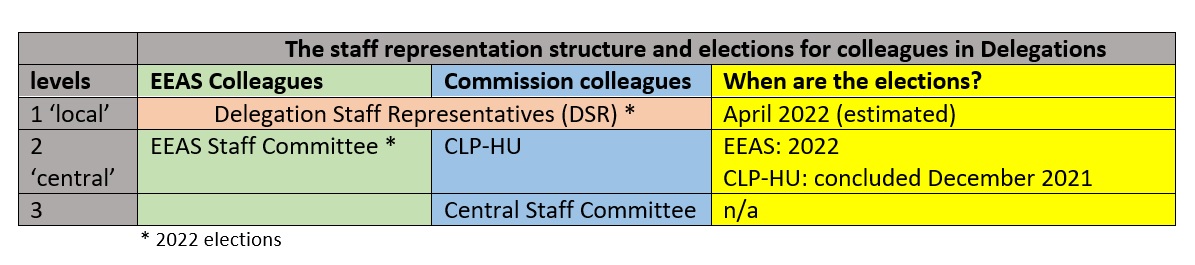
 All colleagues in Delegation, (including Commission colleagues), must vote in April 2022, even those who already voted in December 2021. All colleagues in Delegation have the unusual situation of participating in two elections (levels 1 and 2: see ‘the staff representation structure and elections’ table below). EEAS Colleagues will have their EEAS staff committee election at the end of 2022. [1]
Staff representation at the European Commission is already sometimes rather complicated, and this can be true even on a single site within the EU with a dedicated local staff committee (LSC/CLP) (e.g. Brussels, Luxembourg, Petten, Karlsruhe, Geel or France (Paris)).
The situation can and does become a little more complicated where two sites share a local staff committee, as is the case, for historical reasons, for Ispra and Seville. This relatively limited complexity is somewhat further increased when the 8 LSCs [1] send a small group to the Central Staff Committee (CSC [2]/CCP) which meets 11 times a year [3] and tries to visit a different site each time.
Now imagine if you can, 144 sites worldwide sharing a ‘local’ staff committee and there you have the circumstances of the one LSC not named above. (Well done those of you who spotted the ommission!) The LSC outstanding is the one for outside the Union (CLP-HU). This covers some (but not all) of the 3778 staff [2] at the European External Action Service (EEAS [4]) working either at 143 diplomatic missions and Offices (‘Delegations’) around the world and across all time zones [5] or at the Brussels headquarters (HQ). The EEAS employs staff in categories not found elsewhere (local agents (LAs)) and staff are represented at the level of each of the 144 sites (in Delegations this is what is meant by ‘local’) [3] and then at the level of the EEAS (in Delegations this is what is meant by ‘central’) (and to add to the potential for confusion, there are 2 options there, depending on type of staff). Without even mentioning the CSC, this is complexity multiplied by complexity: so how does it all work?
At all 3 levels of representation (see table below), those elected have a 3-year term in office (‘mandate’) and all colleagues in Delegations are invited to participate in two elections (levels 1 and 2).
 [6]
[6]
So, here for example, the CLP-HU elections concluded in December 2021 [7], but the other level 2 entity, the EEAS Staff Committee [8]will only organise elections late in 2022. The level 1 entity (Delegation Staff Representatives (DSR)) will have elections in April 2022 (please vote when the time comes!).
Structure of the EEAS Staff Committee
This committee consists of 15 full and 15 backup (‘alternate’) members nominated by candidates from HQ and Delegations. Local agents, all statutory staff serving in Delegations under EEAS for more than 3 years would generally be eligible to be a candidate.
Structure of the CLP-HU
This committee consists of 14 full and 14 alternate members nominated by candidates from Delegations only. Local agents, all statutory staff serving in Delegations under EEAS for more than 3 years would generally be eligible to be a candidate.
Structure of the CSC/CCP [9] [4]
 [10]
[10]
[1] If you are working in Delegation, you are either a Commission Colleague (operational sections and finance and contracts) or an EEAS colleague (political section and administration) depending on your contract. We have written to the EEAS Staff Committee for more information on this distinction. We have also asked whether the work of these two level 2 entities overlaps.
[2] See EEAS Annual Activity Report 2020 [11] p. 113 (we’ve written to them to ask whether 1688 is a typo for 3788).
[3] Please note that the same terms (local/central) here being used to mean different things. Here’s a guide:
 [12]
[12]
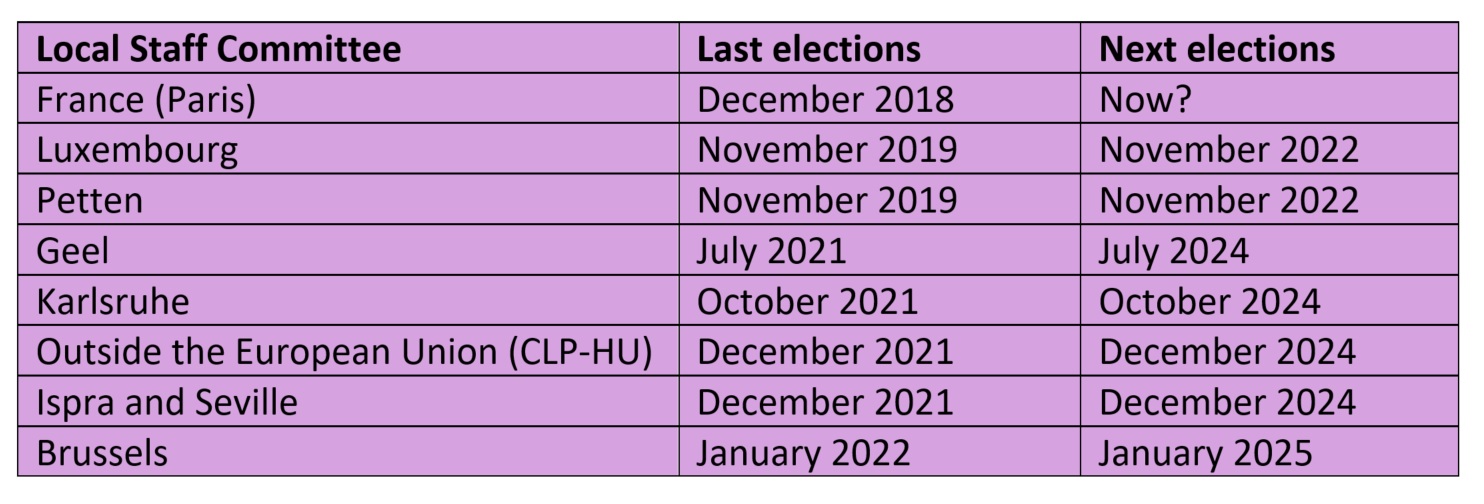
[4] Unfortunately all of the elections [13] across the Commission are out of sync with each other and the CSC is in constant change: all 8 LSCs run on different 3-year cycles. (We have suggested simplifying things [14] and Covid, to a certain extent, synchronised (almost!) the cycles of 4 of the 8 LSCs [15] since they all took place in 2021.)
 [16]
[16]
These are officials, temporary agents (TAs), Contract Agents (CAs), and special advisers. This excludes other staff working for the Commission such as persons employed under private law contracts, experts on secondment from national civil services (SNEs), trainees, and external experts. (Practical guide to staff ethics and conduct [17])
'); toolTips('.classtoolTips39','‘Offices’ is normally used to mean 3 specific services [18]: OIB, OIL and the PMO but not EPSO, the OP or OLAF [18]. Unfortunately, the term is used differently elsewhere, so please always check! The draft Commission budget 2026 [19] (pp. 958-963) uses ‘Offices’ to cover all 6: OIB, OIL, PMO, EPSO, the OP and OLAF as do the General Implementation Provisions (GIP) C(2011)1264 [20].
'); toolTips('.classtoolTips40','Local staff committee for Outside the Union/Comité local du personnel représentant le personnel affecté Hors UnionFor unknown reasons preference is given to the French abbreviation CLP-HU in all texts. LSC-OU is never used and is unlikely to be understood.
CLP-HU is one of the 8 local staff committees: this one is for those in the 143 diplomatic missions and offices outside the EU (‘Delegations’) around the world and across all time zones [5] or at the Brussels headquarters (HQ) of the the European External Action Service (EEAS [4]).
');