 [1]When approaching retirement, you might want to have less stress and enjoy the remaining workdays. This could involve taking longer breaks, being more flexible and work fewer hours to gradually transit into the new well-deserved lifestyle. You might also want to explore new passions and hobbies, visit old family members, or plan a move back to your home country. There are also colleagues who start a new career outside of the EU institutions, but in any case, it is important to plan your future.
When you have completed at least 10 years of active service or reached pensionable age [2], you are entitled to a pension. The key factor is your date of entry into service under the staff regulations, but there can be specific situations affecting retirement rights, for example, changes in status during a career, transfers between EU bodies, previous service that is recognised and invalidity retirement.
During your career, you have acquired pension rights for each year of service. The accrual rate of 1.8, 1.9 or 2% depends on the date you were recruited and the total pension rights are calculated on the basis of your final basic salary. With the past reforms of the Staff Regulations, the accrual rate went down. If you started in 1996 and worked until now on the same contract, the 2% rate is applied for the whole career. If you had several types of contracts during your career (contract agent, temporary agent and official) it might be that your pension accrual is calculated in tranches, with different rates applying to different periods of service:
| accrual rates | |
| Before 1 May 2004 | 2.0% per year |
| From 1 May 2004 | 1.9% per year |
| From 1 January 2014 | 1.8% per year |
If you entered before 1 May 2004 and had at least 20 years of service on that day or turned 60 or more on the 1 May 2014, you probably already retired as your pensionable age was 60. You acquired 2% of pension rights for each year of service. Your total pension rights were calculated with reference to your final basic salary, and the maximum amount of your pension was 70%.
If you entered before 1 May 2004 and had less than 20 years of service on 1 May 2004 and was under 60 on 1 May 2014, your pensionable age is as follows:
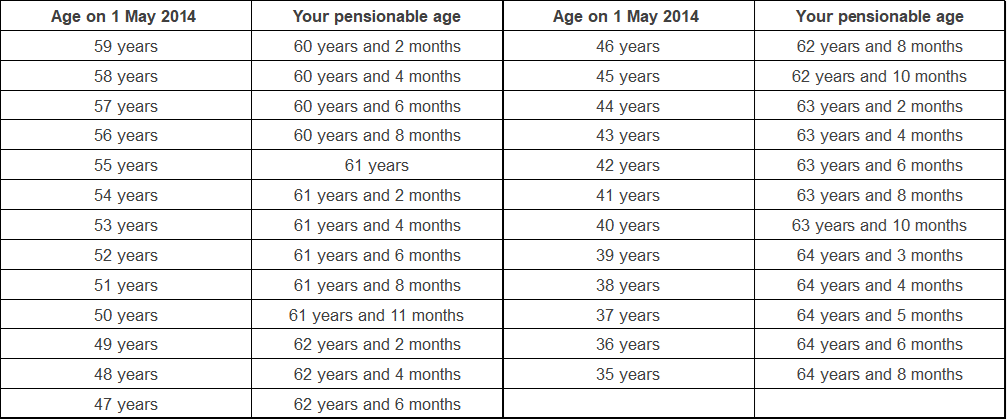 [3]
[3]
If you belong to this category, you acquire 2% of pensions rights for each year of service if you have the same contract since you started, even if the accrual rate changed. Your total pension rights are calculated with reference to your final basic salary, and the maximum amount of your pension is 70%.
If you entered between 2004 and 2013, your pensionable age depends on your age on 1 May 2014:
| Age on 1 May 2014 | Your pensionable age |
| 45 years or more | 63 years |
| 44 years | 63 years and 2 months |
| 43 years | 63 years and 4 months |
| 42 years | 63 years and 6 months |
| 41 years | 63 years and 8 months |
| 40 years | 63 years and 10 months |
| 39 years | 64 years and 3 months |
| 38 years | 64 years and 4 months |
| 37 years | 64 years and 5 months |
| 36 years | 64 years and 6 months |
| 35 years | 64 years and 8 months |
| - than 35 years | 65 years |
You acquire 1.9% of pension rights for each year of service (if you have the same contract during the whole career). Your total pension rights are calculated with reference to your final basic salary, and the maximum amount of your pension is 70%.
If you entered on or after 1 January 2014, your pensionable age is 66. You acquire 1.8% of pension rights for each year of service and your total pension rights are calculated with reference to your final basic salary.
You can also opt for an early retirement at 58 if you, when reaching 58, have completed 10 years of service. If you were recruited 2014 or later, your pension rights will then be reduced by 3.5% for each year not completed between 58 and your pensionable age.
If you were recruited before 1 May 2004 or between 2004 and 2013, your pension rights are reduced by 3.5% before the age of 60 and by 1.75% between 60 and your pensionable age.
Important to know is that the system only considers the final salary if you have been in the grade for at least one year. Hence, if you get promoted on the 1st of January 2026 and plan to retire in the coming months, it would be a better financial decision to leave on the 31st of January 2027 instead of 30th of November 2026.
Use the pension calculator [4] to have an estimation on your pension and what difference it would make to work a little longer. If you have a mixed career, we recommend asking PMO via Staff matters.
The minimum amount of your retirement pension cannot be less than 4% of the minimum subsistence figure per year of service (basic salary of grade AST 1/1 x years of service) and the maximum pension you can get is 70% of your last basic salary.
To clarify the calculation of the minimum amount here is a simplified example:
If you retired after 10 years of service on the 1 of January 2026 and your final salary as 5000€/month and the normal applicable accrual rate was 2% you would get 2%x5000€x10=1000€. The basis for the calculation of the minimum amount is the basic salary of grade AST1/1=3754.39€ (07/2025).
4%x3754.39×10=1501.76€. With this rule staff members with shorter careers and/or lower salaries get a compensation. This is also considered if you use the pension calculator. If we use the same example but change the career to 20 years, the person got 3003€ as a minimum pension instead of 2000€.
Remember that you will continue to receive family allowances if you are still entitled to those (household allowances, dependent child’s allowance and education allowance). You also continue to contribute to the sickness scheme (1.70%), and you continue to pay tax. You do not receive the expatriation allowance (16%) or the foreign residence allowance (4%) after retirement, and you do not contribute to the solidarity levy or to the pensions scheme.
If you continue to work beyond your pensionable age, until 65, you get a bonus. If you started before 1 January 2014, you get 2,5% bonus per year after your normal retirement age. If you started later, you get 1.5% per year after you turn 66. According to the Statistical Bulletin for Commission on 1 July 2026 [5] 32 staff members, 23 men and 9 women, aged 67 years or more are still working.
There are several possibilities to reduce working-time before retirement. During the last 3 years before retirement age, from the age of 58, you have the option of applying for a part-time work arrangement [6], but only if you were recruited before 1 January 2014. This arrangement is possible until the age of 65. You can still choose to contribute 100% for your pension rights on the basis of a full-time salary. If you were recruited after 1 January 2014 you are entitled to work half-time between the age of 63 and 66.
Part-time work may also be authorised in the form of time credits [7]. This means that you can purchase 10.5 days (equivalent to 21 half-days) or 21 days (equivalent to 42 half-days) and use these days during a 12-month period. These days will be added under a special ‘time credit’ tab and at the same time your annual leave entitlement will be proportionally reduced. Your monthly salary will be reduced by 50% for each purchase of 10.5 days.
There is also a possibility to take leave on personal grounds [8] (CCP), but your career is during this period put on hold and you do not qualify for advancement to a higher step or promotion.
Another important thing to remember is to subscribe to an accident insurance as you will lose the accident insurance provided for by the Staff Regulations for staff in active employment. Your coverage for disability or death due to an accident ceases. There is also a possibility to take an insurance without accident cover (top up cover) before you retire which cover for medical expenses arising only from illness. The reimbursement of 100% of the difference between the amount paid by the JSIS and the actual expense in the case if hospitalisation, surgery, and outpatient care.
The insurance broker Cigna/Eurprivileges [9] can give you more information about the accident insurance [10] or the hospitalisation insurance [11]. Also Afiliatys [12] and Allianz can offer the HOSPI SAFE coverage.
Subscription should be taken before the date of retirement as some of the collective insurances have such rules.
When you have finally taken the decision, you can submit your request for retirement 3 months before up to maximum one year before your desired and well-deserved pension date.
Do not forget to keep the Pensions unity (PMO/02) informed about your personal situation once you have retired. It is up to the pensioner to provide proof of their new place of main residence which for some colleagues can be difficult if they keep a second residence in another Member State [13]. An administrative investigation may be initiated if there are doubts about the pensioner’s genuine place of residence, including checks such as geographical breakdown of medical expenditure, volume of consumption of water and electricity or unannounced on-the-spot checks.
There is an annual adjustment of your pension every year retroactively calculated from 1st of July.
Retirement is a process, and you should prepare both mentally and practically to ensure a smooth transition.
In EU Learn you can apply for a two-day seminar [14] designed to support you to ensure a smooth transition into retirement. There is also a half day interactive workshop – Prepare for your life after retirement – Retiring with philosophy [15] for staff in Brussels as well as a two-day ‘classroom’ course available both for staff in Belgium and Luxembourg.
There is also a new platform – Offboarding – Pathway to retirement [16] available with a step-by-step guide towards this new phase in your life and here is a PMO guide on pensions and invalidity allowances [17]
You can also join the Association of Former Staff of the European Union [18] (AIACE) with section in many EU-countries or the Association of Seniors of the European Public Service (SEPS/SFPE) [19] who both defend the interests of former European civil servants.
Generation 2004 calls for a fair and equal pension system and will strongly defend staff in any future discussions on the rules.
Here is more information and FAQs on general pensions [20] on our webpage.
toolTips('.classtoolTips19','Staff Regulations of Officials and the Conditions of Employment of Other Servants of the European Union (\'Staff Regulations [21] (SR)\') are rules stating:
• fundamental conditions of service
• basic rights, duties and obligations of staff.
The SR have been reformed x 2 (so far):
• 2004 (Kinnock White paper)
• 2014 (Regulation 1023/2013 [22])
For a summary of stated intentions and real outcomes of those two reforms check out: European Court of Auditors, 2019, Special report no 15/2019 [23]: Implementation of the 2014 staff reform package at the Commission – Big savings but not without consequences for staff
'); toolTips('.classtoolTips34','A new Procedural Handbook for Invalidity Committees was published 25.11.2022 de [24] | en [25] | fr [26]
See also Special Report No 3/2003 on the invalidity pensions scheme of the European institutions, together with the institutions’ replies [27]
See also Staff Matters - Corporate - Invalidity [28] (Home [29]>Staff Matters [30]>Health [31]>Specific events [32]>Invalidity) and the calculation of the allowance [33].
Under certain circumstanaces you can work elsewhere while in receipt of an invalidity allowance:
\'Persons in receipt of an invalidity allowance may not engage in gainful employment without the prior authorisation of the Appointing Authority. Any income from such gainful employment which, in combination with the invalidity allowance, exceeds the final total remuneration received while in active service as determined on the basis of the salary scale in force on the first day of the month in which the allowance is to be paid shall be deducted from the invalidity allowance.\' Staff Regulations, VIII Pension scheme [34], Article 13(2)
'); toolTips('.classtoolTips47','Trade union or staff association (OSP) [Organisation syndicale et professionnelle]'); toolTips('.classtoolTips48','Office for the Administration and Payment of Individual Entitlements');