 A respectful workplace is where integrity, fairness, collaboration, professionalism and trust are the norm. It involves treating colleagues with dignity, fairness, and kindness, creating a safe environment where everyone feels valued and comfortable, regardless of background or position.
Respect in the workplace includes active listening, open communication, valuing diversity, and adhering to professional, ethical standards, which boosts morale and productivity.
On 24 March, DG HR released the results of the 2025 survey [1] on respect, diversity and inclusion. A joint action from the Diversity and Inclusion Office, the EEAS Resources Management department and the Chief Confidential Counsellor (CCC). Trade unions, staff associations and staff representatives were consulted in its preparation. DG Justice, Eurostat, and the Fundamental Rights Agency provided best practices in terms of equality data collection.
The 2025 edition follows a previous one dated back to 2021 (first edition).
The 2025 survey on respect, diversity and inclusion
The survey was carried out in May 2025. It complements the Commission’s 2022 Human Resources Strategy [2], the 2023 renewed anti-harassment policy [3] (practical implementation of the prevention principle enshrined in Article 17(2)) as well as the Diversity and Inclusion Action Plan 2023–2024 [4].
The 2025 survey was distributed to all staff members of the Commission (including Delegations and Representations), of the EEAS (including Delegations and local agents) and of the six Executive agencies. Compared to 2021, it ‘was expanded to provide a more detailed and up-to-date picture of colleagues’ perceptions of harassment in the workplace.’ Also, it includes data on prevalence, reporting behaviour, and satisfaction with support services.
The respondents accounted for 10,186 colleagues (17.4% response rate of the population invited to take part). Considering the total Commission Staff in January 2025 [5] (i.e. 32,860 individuals), the response rate is very low. This response rate does not allow for conclusions to be drawn for all staff.
The most represented age groups were respondents between 40 to 49 years old as well as between 50 to 59 years old (mostly Commission’s staff). This range of age/sex coincides mostly with the age range/sex of the victim for psychological harassment as identified among those colleagues who have applied to the intervention of the CCC office in the first year of activities (188 out of a total of 312 victims who perceived harassment, CCC first report, p. 12 and 13).
The Commission’s respondents with less than 30 years old was very low (6.1%). This low participation is followed by a low demand to the CCC office in the first year of activities (22 out of a total of 312 victims (requests handled by the CCC office and ‘Age range’, Annual report, p. 12 and 13).
Most respondents were women (mostly Commission’s staff). They were overrepresented (53% against 40% of men responses). A small proportion of respondents (0.4%) identified as non-binary, while 6.1% decided not to disclose their gender.
With regards to ‘employment status’, 51.4% of the respondents were officials, followed by 24.9% of Contract Agents (CA FG IV (55.1%) or AST or CA FG III (21.4%) positions), and followed by temporary agents with 9.1%. The remaining categories accounted for 13.1%.
72.6% of the respondents (7,395 individuals) works for the Commission, followed by Executive Agencies. Altogether, 11.6% of respondents work in EU Delegations. Local agents in EU Delegations were also included in the 2025 survey, which was not the case in 2021. They accounted for 4% of the total population of respondents, and 21.5% of the EEAS population of respondents.
Respect in the workplace: key findings
A positive key finding from the survey is the existence of a growing awareness and knowledge of the procedures regarding harassment (section 3.1.2, p.18), which is widely confirmed by the CCC office annual report and by the 2025 Staff survey outcomes.
A large majority of respondents have not personally witnessed or experienced behaviours associated with psychological harassment (figures range from 60.1% of respondents not encountering “offensive or degrading comments” to 86.4% not encountering “sharing messages of a private nature without consent.”). A very small minority of respondents detected behaviours associated with sexual harassment. By contrast, the CCC office registered in the first year of activities, a total of 28 cases of perceived sexual harassment. Positively, in general, inappropriate behaviours have decreased since the 2021 survey.
Concerning behaviours that could potentially qualify as psychological harassment, 60.4% of responses are associated with vertical power (a line manager (Head of Unit/Division – Head of Delegation), supervisory role and senior management) overall. The vertical power is also confirmed by the requests of assistance made to the CCC office (206 out of a total 312 cases of perceived psychological harassment by a hierarchical superior, Annual report, p.13). Another relevant finding relates to the fact that most colleagues feel that the psychological harassment they experienced or witnessed was from their hierarchy (see section 3.2.2, p. 22). This trend is confirmed in the first Annual Report of the CCC office, p. 13).

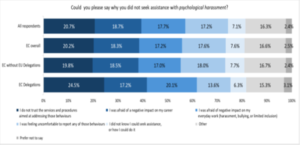
Seeking assistance and reporting does not look pretty in the responses collected because most of the respondents who personally witnessed or experienced behaviours that could be associated with harassment did not seek assistance or report the incident (see section 3.2.6 p. 26 and seq.). The barriers are the lack of trust in the procedures in place (ranging from 20.7% for psychological harassment to 19.9% for sexual harassment), the fear of negative consequences to career prospects (18.8% for psychological harassment, 14.2% for sexual harassment) or everyday work (17.7% for psychological harassment and 15.6% for sexual harassment) and feeling uncomfortable (17.2% for psychological harassment and 20.6% for sexual harassment).
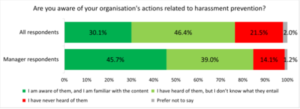
The results concerning managers and harassment are mixed (i.e. with a combination of positive and negative aspects). There is, indeed, more awareness of harassment prevention measures by managers (84.7% vs 76.5% overall). However, as said above, 60.4% of all responses were associated with vertical power. Satisfaction with support from line managers for psychological harassment is polarised, with 28.3% respondents satisfied or very satisfied, and 44.6% dissatisfied or very dissatisfied. Despite, the targeted actions to managers displayed by the CCC office in 2024 and 2025, including a compulsory training for managers as set out in Article 16(2) of the 2023 Commission decision, further training programmes and awareness raising campaigns are needed, notably with a focus on the recognition of inappropriate behaviours and bystander intervention.
Finally, the report scores support provided by staff representatives largely positive as well as by the medical services and confidential counsellors. Differently, lower rating is given to support provided by HR services, line managers and senior management.
Zero-tolerance for harassment
The Commission is a multicultural organisation, with 27 nationalities and 24 languages. The perceptions of the staff regarding respect, diversity and inclusion are different today from the past because its population evolves and change across the decades. New EU generations and old EU generations are still sharing the same workplace, and they must adapt each other. Misunderstandings can easily arise, but communication should be transparent, inclusive and polite. Above all, we all need to behave respectfully towards our peers, managers and staff.
Generation 2004 is committed to build on ways to ensure a respectful work environment. The review of the 2023 Commission decision on harassment is certainly a great occasion to work together with the CCC office, HR services, Mediation service and other relevant stakeholders in assessing the effectiveness of the policy, identifying areas, and gathering suggestions for improvements. Respect at work is therefore a necessary and preliminary step to reach a zero-tolerance culture for harassment.
toolTips('.classtoolTips12','In English psychological harassment is more commonly known as bullying. Here it would be specifically workplace bullying.
The C(2006) 1624/3 [6] Commission decision on the European Commission policy on protecting the dignity of the person and preventing psychological harassment and sexual harassment Section 2.1 lists examples of this behaviour.
The update, C(2023) 8630 [7] Commission decision on the prevention of and fight against psychological and sexual harassment, and repealing Decision C(2006) 1624/3 point 8, page 2 lists examples of this behaviour.
Check out these videos How to tell if you’re being bullied at work? [8] and Workplace bullying [9] for more examples.
'); toolTips('.classtoolTips14','We understand that 7000 of the c. 10000 respondents to the March 2021 HR diversity and inclusion survey chose to answer the section relating to harassment. The results were expected to be ready 14.10.2021. *Update 01.07.2022: HR D&I survey results (including those from the optional section on harassment) are available under DG HR survey results: Reports/metrics [10]. A summary is in April 2022 Central Staff Committee (CSC) plenary [11]. *
‘The Diversity and Inclusion Office is working on a new Diversity and Inclusion Action Plan, due to be released in Q4 2021. It will be an update since the last report in 2019 to reflect new priorities.’ (My Intracomm, Staff Matters, Diversity and Inclusion [12], Ongoing projects and events)
'); toolTips('.classtoolTips23','Contract Agents (CAs) were created by the 2004 staff regulations Reform. There are two types of CA: those with unlimited contracts, 3A [13] (‘indefinite’) and those with time-limited contracts [14], 3B [15]. CAs can belong to 4 different function groups (\'GF\') with different responsibilities and salaries [16].
As the use of contract staff becomes increasingly common, there has been a corresponding increase in the diversity of status and pay of the Commission’s workforce. For example, GFIV contract staff meeting the same minimum recruitment requirements (education and experience) as junior administrators may earn 28 % less. (European Court of Auditors, 2019, Special report no 15/2019 [17]: Implementation of the 2014 staff reform package at the Commission – Big savings but not without consequences for staff, point 61, page 34)
We have a working group dedicated to the dossier, and in December 2012 we addressed the first of many letters (\'notes\') about Contract Agents to Human Resources of all Institutions and Agencies [18] (here is the cover e-mail [19]).
As a background you can see the report of the Commission to the Council regarding the recruitment of the contract agents in 2010 [20] (in French, COM(2011)802 final 23.11.2011).
Our articles on Contract Agents [21]
'); toolTips('.classtoolTips38','Agencies (in general) can be either:- the >40 decentralised organisations [22] with seats throughout the EU which are created by a specific legislative act and charged with a particular task\' e.g. Europol, the EMCDDA , the European Union Agency for Fundamental Rights (FRA) and Frontex.
- the 6 Brussels-based Executive Agencies [23] which are \'legal entities established ... with a view to being entrusted with certain tasks relating to the management of one or more European Union programmes. These agencies are set up for a fixed period.\' They are CINEA, EACEA, HADEA, Eismea, ERCEA and REA.