 *Update 17.09.2024 check out the pros and cons of screening [1]: this is the reasoning given behind the decisions below. We also invite you to check the uneven/inequal cancer outcomes observed in Europe’s Beating Cancer Plan [2].*
Original article: Generation 2004 has heard from several of you concerning your difficulties in navigating the new systems to have screening tests reimbursed at 100%, now that the medical service is no longer providing the so-called ‘bon rose’. That way of authorising specific tests outside the Medical Service was withdrawn in February 2023 [3][1].
Many such tests are now relatively hidden within a preventive-health screening programme [4] and their scope of application and frequency modified (often reduced) meaning that their application may or may not correspond with the 2022 EU cancer screening recommendations [5]! This is disappointing, given that a number of these tests are a very important means of cancer detection.
Please check and use what you’re entitled to! For how to do so see Where to see what you’re entitled and get the paperwork further down here.
Examples of tests which have changed
- A (normally) annual gynaecological check-up including cervical cancer (Human papillomavirus (HPV)) screening and/or a mammogram: now reduced to every 2 years with the mammogram reimbursed at 100% from 50 years onwards only. The 2022 recommendations are for a mammogram from 45 years onwards.
- A prostate-specific antigen (PSA) test now available every 4 years. While the 2022 EU cancer screening recommendations [5] offers no recommendation with regards to frequency, elsewhere it is recommended for every 2-3 years [6].
What’s the context?
Generation 2004 believes this change to the rules to be a very worrying move towards reduced prevention and less care for staff health, particularly when cancers of all kinds can be much easier (and cheaper!) to treat when found early.
We are very worried for colleagues at the lower end of the salary scales [7]: this decision may hit women particularly hard, given the larger spectrum of tests involved [2]. Colleagues who find themselves lower in the salary scales have already been hit hard by rising inflation (and perhaps also by a negative salary adjustment [8]) and might decide to avoid having a pap test or a mammography because they have not realised that, while it is still possible to have the 100% reimbursement, it’s a bit more difficult to find the forms or even to know that they exist! Money is tight, colleagues are burned out [9] from being constantly connected [10] and here we have additional hurdles to medical checks.
When we enquired about this, DG HR directed us to the Staff Matters health screening [11] itself. Apart from the fact that many staff members are not aware of health screening, and DG HR is making no visible effort to raise awareness about them (was this a decision or an oversight?), the frequency and scope of those tests may also have changed. Additionally, screening programmes can only be done every 2 or 5 years, according to the screening type, while the annual medical check-up is in fact…yearly, as were the bons roses!
“… 1 in 2 people in the UK born after 1960 will be diagnosed with some form of cancer during their lifetime. Females have the highest lifetime risk of breast, lung and bowel cancers.” (Cancer risk statistics | Cancer Research UK [12])
“Cancer is a leading cause of death worldwide, accounting for nearly 10 million deaths in 2020, or nearly one in six deaths. The most common cancers are breast, lung, colon and rectum and prostate cancers. (…) Many cancers can be cured if detected early and treated effectively.”(Cancer (who.int) [13])
Concerning e.g. breast cancer, the WHO reports 2.26 million cases detected and 1.8 million deaths in 2020 alone. The EU is well aware of this and has developed the so called ‘Beating Cancer Plan’.
“In 2020, 2.7 million people in the European Union were diagnosed with cancer, and another 1.3 million people lost their lives to it, including over 2,000 young people. Unless we take decisive action now, cancer cases are set to increase by 24% by 2035, making it the leading cause of death in the EU.
Europe’s Beating Cancer Plan will have €4 billion of funding, including €1.25 billion from the future EU4Health programme.”(A cancer plan for Europe (europa.eu) [14])
Generation 2004 strongly reminds our administration that such principles and concerns should also apply to staff: the Commission must walk the talk!
Making savings on detection are a false economy: as the recorded instances of cancer rise – also among younger adults – more and more colleagues will face longer and more expensive treatment for cancers which are found later than they might otherwise have been. More taxpayer money will be spent on absences and treatment reimbursement. Everybody with a basic understanding of health systems knows this is absolutely wrong!
Who signed off on this?
In this discussion on Myintracomm [15], the Head of the Medical service indicates that changes to the annual medical check-up were discussed with the Local and Central Staff Committees and with the Commission health and safety committees (CPPT (Brussels)/CSHT (Luxembourg)). However, even if a general overview of the change were presented and we were there to question them, details concerning a reduction of cancer-detection-testing scope were never provided in those contexts. So staff representatives never approved of such changes!
What if I need the test but it’s not listed for me?
Remember you can still do any screening tests [16] without the additional forms, the only issue is that you will receive the normal JSIS reimbursement, i.e. 80-85% (up to a ceiling) only. Up to now, being part of the annual medical check-up, these tests were reimbursed at 100% so long as you remembered to ask for the bon rose at your annual check-up at the Medical Service.
Share your experience!
If you asked to have any tests e.g. gynaecologist consultation, a mammography or a PSA within the framework of the annual check-up and were denied them, please let us know!
Please also follow the procedure outlined here [4] in parallel and ensure that you do the tests. If something is concerning you, please don’t delay in getting tested, the repercussions of waiting could be very serious indeed.
Do you believe that these cuts on cancer-prevention testing are unacceptable? Write to us [17]! Do you see how it might have a particularly detrimental effect on women? Only with prevention and care from all staff: all of us looking out for each other, can we collectively ensure that cancer is no more difficult than it needs to be!
Where to see what you’re entitled and get the paperwork
Go to JSIS online [18]>CREATE A REQUEST>Health screening invitation request. you will see there the options available to you and their period of validity.
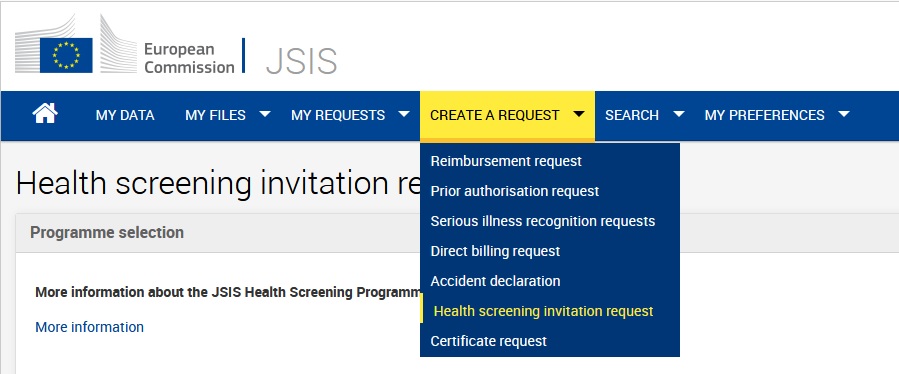
When you receive confirmation that the invitation is available for you to download you will find it in the same location from where you made the original request.
We’re here for you!
If you appreciate our work, please consider becoming a member of Generation 2004 [19].
———————————————————————–
[1] Update 30.11.2023: We have clarified via staff contact that routine eye/vision tests must be prescribed by the doctor as part of the annual check-up, otherwise they are reimbursed at the normal rates. This is what is meant (but rather unclear) by the MyIntracomm [20] statement that the test is reimbursed at 100% ‘if medically indicated’. If you already have complementary health insurance [21] then this modification of testing changes nothing for you: you should continue to receive full reimbursement of the part not paid by the JSIS.
[2] Women are disproportionately found lower down the salary scales at the Commission: women are 77% of AST/SCs and 79% of FGII Contract Agents (October 2023 [22]).
toolTips('.classtoolTips23','Contract Agents (CAs) were created by the 2004 staff regulations Reform. There are two types of CA: those with unlimited contracts, 3A [23] (‘indefinite’) and those with time-limited contracts [24], 3B [25]. CAs can belong to 4 different function groups (\'GF\') with different responsibilities and salaries [7].
As the use of contract staff becomes increasingly common, there has been a corresponding increase in the diversity of status and pay of the Commission’s workforce. For example, GFIV contract staff meeting the same minimum recruitment requirements (education and experience) as junior administrators may earn 28 % less. (European Court of Auditors, 2019, Special report no 15/2019 [26]: Implementation of the 2014 staff reform package at the Commission – Big savings but not without consequences for staff, point 61, page 34)
We have a working group dedicated to the dossier, and in December 2012 we addressed the first of many letters (\'notes\') about Contract Agents to Human Resources of all Institutions and agencies [27] (here is the cover e-mail [28]).
As a background you can see the report of the Commission to the Council regarding the recruitment of the contract agents in 2010 [29] (in French, COM(2011)802 final 23.11.2011).
Our articles on Contract Agents [30]
'); toolTips('.classtoolTips47','Trade union or staff association (OSP) [Organisation syndicale et professionnelle]');