 One may rightfully assume that employees in the EU are protected by laws and instruments to limit precariousness. And while we know that in the European Commission we can find countless perverse counter examples, what you probably don’t know is that the European Schools (EURSC) take this to the next level. EURSC locally recruited teachers (LRT) find themselves in a legal void that makes their jobs and lives a constant walk on a net free tightrope…
On 30 March 2022 LRTs organized a demonstration march. In their support, a representation of Generation 2004 marched along a group of about 250 other demonstrators from the Schuman roundabout to the Office of the Secretary General of the EURSC. Other colleagues, parents and pupils from Frankfurt, Varese, Alicante and other locations supported the action online.
LRTs were not demanding salary raises, better working environment or any other tangible improvements to their working conditions; instead they were asking for the right to have Union representation and proper and legally binding contracts under national law. It is really unbelievable that in the XXI century EU, someone exercising any profession still needs to ask for such things that we all take for granted.
European Schools teachers are split into two categories, about half are provided by EU Member States (seconded teachers) – they are covered by national law of their countries of origin and EU law as a level of appeal, and LRTs hired locally by the LSC. The latter are paid much less and have very precarious ‘contractual’ relationship with the schools.
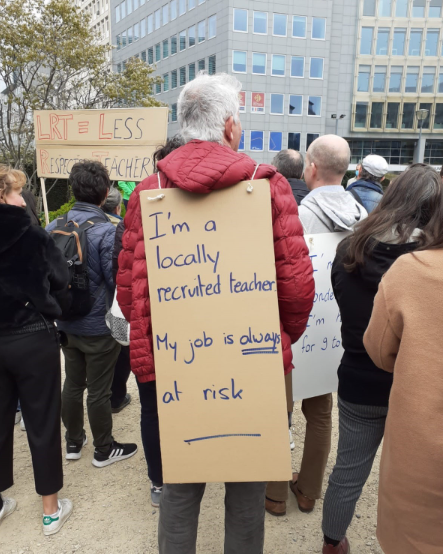 Since the EURSC was established by an international convention among the EU Member States but outside of the EU legal framework, it is not a EU institution or body, nor is it a national organization. This institutional void has so far allowed the system to challenge national and EU legislation regarding employment disputes on the basis that the School System is above national law and also not under EU legal jurisdiction.
Therefore, LTRs find themselves in a surreal legal vacuum, where, for instance, their representatives have no job protection and risk loosing their jobs overnight if they challenge decisions too strongly. In fact, the highest power that local teachers can appeal to is the European Schools’ system itself, which is also the power oppressing them. Currently the LRTs movement is trying their luck with the European Ombudsman; the European Commission has a sit in the EURSC Board of Governors (BoG) and that sit usually is followed by many of the EU Member States members of the BoG so pressure on the Commission could help change things for the better. That failing we believe that the only other level of appeal would be the Strasbourg court of Human Rights… Far fetched but not to be outright discarded. So, in practice, and very ironically, LRTs are denied all the principles that they are supposed to teach to young pupils at the school.
At the end of the march on March 30, at the EURSC’s headquarters, the EURSC Secretary General, Mr. Beckmann, listened to the teachers’ demands and expressed some sympathy to accept the possibility of Union representation. However, the teachers’ demands for stable contracts was not assured at all. In fact, Mr. Beckmann stated that the system must reach in the future the ratio of 65% seconded vs 35% locally recruited teachers, which already anticipates a loss of posts for many teachers already in a very precarious situation.
Against this backdrop, Generation 2004 expresses its full support for locally hired teachers and condemns the current situation in the strongest terms, which it considers not worth of a European organization that is as close to the heart of the European Union project as it can get: educating the children of the European Institutions members of staff!
As always, we welcome your feedback.
