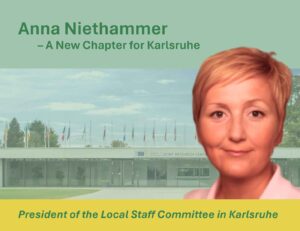
 Following the Local Staff Committee (LSC) plenary meeting held in Karlsruhe on 6 October, we are delighted to announce that Ms Anna Niethammer, an elected representative of Generation 2004, has been appointed President of the Local Staff Committee in Karlsruhe.
We warmly congratulate Anna on her appointment and wish her every success in her new role. We hope that this positive development will set a precedent for other JRC sites in their upcoming elections, further strengthening the representation of Generation 2004.
To mark this occasion, we invited Anna to answer a few questions, giving colleagues the opportunity to get to know her better and learn more about her vision and priorities.
To begin with, Anna, could you tell us a little about yourself, your background and what motivates you, so that colleagues can get to know you better on a personal level?
First of all, thank you for the opportunity to introduce myself. After graduating as a registered nurse in Poland, I moved to Germany in the mid-1990s, where I gained extensive leadership experience across various specialized clinical departments. In 2010, I joined the Joint Research Centre (JRC) in Karlsruhe as an official within the medical service. While my primary role centered on staff healthcare, this daily contact inspired me to look beyond purely medical needs. I developed a deep passion for the broader concerns, professional well-being, and interests of everyone in our working environment. On a personal level, I am deeply driven by a sense of fairness, compassion, and the satisfaction of making a tangible difference in people’s daily lives. Ultimately, it was this dedication, combined with a desire to embrace new challenges, that motivated me to step up and actively advocate for my colleagues.
What motivated you to stand for position of President of Local Staff Committee in Karlsruhe?
Throughout my years working as a nurse at JRC Karlsruhe, I have had the privilege of meeting colleagues from many different backgrounds, nationalities, and staff categories. This has allowed me to build deep, trusting relationships while gaining a genuine understanding of the daily challenges we face in our working lives. As a nurse, listening to people, supporting them, and advocating for their needs have always been at the core of my professional identity. Over time, I felt a strong desire to take this commitment a step further and make a positive difference for our entire staff community. Standing for the position of President of the Local Staff Committee was therefore a natural continuation of what I have always believed in: putting people first, listening to their concerns, and finding practical ways to improve our working environment. I truly believe that the trust and connections I have built over the years provide a strong foundation to bring us closer together and dynamically strengthen our collective representation.
What experience and personal qualities would you bring to this role?
I believe my greatest strengths are my ability to listen, my approachability, and the trust I have developed with colleagues over the years. Working in healthcare has taught me to be attentive, empathetic, discreet, and solution-oriented. It has also trained me to remain calm in difficult situations, understand different perspectives, and respond to challenges with both sensitivity and pragmatism. Another key asset is my deep knowledge of the site and its people across different services and professional categories, which gives me a broad perspective on staff concerns. At the same time, I firmly believe that leadership is not about having all the answers. It is about bringing people together, encouraging open dialogue, and finding solutions collectively. My goal is to be a President who is accessible, listens without judgment, and reliably follows through on commitments.
Could you please tell us what your plans and priorities are for your mandate?
On a broader level, my overarching goal is to strengthen communication and trust between staff, the Staff Committee, and the management. Staff well-being will also remain central to my work. Given my medical background, I am particularly sensitive to the impact of workload, stress, and the working environment on physical and mental health. Furthermore, I want to give JRC Karlsruhe a stronger voice within the institution. My ambition is to ensure that the realities and structural challenges affecting different staff categories at our remote site are more visible at the central level so they can be adequately addressed. To achieve this, I also plan to foster closer cooperation with other JRC sites, as we often share very similar challenges due to our remote locations.
Beyond the broader priorities of your mandate, are there specific issues affecting JRC Karlsruhe site that you would like to would like to make tangible progress on?
Yes, there are three concrete priorities I would like to focus on:
Addressing recruitment and career mobility
The first priority concerns staff policy, where I see two important issues. First, the JRC needs scientists, but it also relies on qualified technical staff to support its daily activities – such as technicians who deal with ventilation, heating, maintenance, and other essential systems for our buildings and facilities. Recruiting people with these technical skills is not always easy, so I would like to discuss how we can improve this situation and investigate whether competitions could be better adapted to the specific needs of the JRC. Second, colleagues working at JRC sites as Contract Agents or on other non-permanent contracts often face difficulties finding new career opportunities within the European Commission once their contracts end. Even colleagues with permanent contracts can find it challenging to move to another position or develop their careers due to fewer opportunities available locally.
Extending the MyCommuting system to Karlsruhe
The second priority concerns commuting costs and the possibility of extending the MyCommuting system to Karlsruhe. While colleagues in Brussels benefit from this transport reimbursement scheme, colleagues in Karlsruhe would also greatly appreciate access to similar support. We know that commuting conditions vary across sites, so I would like to discuss how commuting costs in Karlsruhe can be accounted for and reimbursed under the central scheme. This is something that many colleagues have been asking for and are looking forward to.
Modernising Karlsruhe elections to the Local Staff Committee
The third priority is to look at how we organise our elections and whether we can make the process easier and more modern. Participation in the last elections was already very good, which shows that colleagues are interested in staff representation. However, I believe it would be useful to discuss the possibility of introducing electronic voting, either partially or fully. Electronic voting could make it easier for more colleagues to participate, especially those who are working remotely, travelling, or unable to vote in person, while also making the process simpler and more efficient. Of course, we would need to ensure that it is secure, confidential, and reliable. My intention is simply to open discussions on whether modern technology can help us improve participation and representation even further, without suggesting that the current system is not working well.
What is your vision for the Staff Committee over the coming mandate?
I want colleagues to feel that the Local Staff Committee in Karlsruhe is close to them, genuinely interested in their concerns, and responsive, meaning they always receive clear feedback on the issues they raise. Making our work more visible is crucial to me. Staff should clearly see what we are working on, what progress is being made, what challenges remain, and how their input directly translates into action. Above all, the Committee should not be viewed merely as a body that intervenes when a problem arises. My vision is for it to be a proactive space where new ideas emerge, constructive dialogue takes place, and lasting improvements are developed together.
What message would you like to share with colleagues who appointed you?
First of all, I would like to sincerely thank my colleagues for their trust and confidence. Being appointed President of the Local Staff Committee is both a great honour and a responsibility that I take very seriously. Many of you know me through my work as a nurse, through our everyday interactions, or simply through the years we have spent together at the Karlsruhe site. Those relationships mean a great deal to me, and I look forward to building on them in this new role. I want you to know that I will approach this mandate with the exact same commitment that has guided me throughout my professional life: listening, supporting, and doing my very best to make a positive difference for all of us.
Thank you for this interview. We wish you the best of luck in your new role!
