 *Update 03.03.2024: the contact number listed on p.2 of the account sheet is out of date, please use number listed here.*
Original article: This can and does happen relatively frequently. First of all, don’t panic! But please do be aware that there is a 3-month time limit[1] on taking a non-reimbursement issue as far as you can before embarking on legal action. Challenging a decision not to reimburse is therefore not an administrative step to save for when you have the time, you really do have to make the time (especially if you need to get a more detailed bill from the health-service provider, for example or investigate whether a precedent has been set for reimbursement).
We understand that this might place a significant administrative burden on you when you are already unwell. Nevertheless, you have to start somewhere: have a look at the reimbursement account sheet itself, there are good instructions on the steps available to you on page 2 and an extended explanation of those steps on staff matters.
To give a real-life example, even the situation below was solved, though it did take quite a bit of work (on all sides) and some blood, a lot of sweat and many tears.
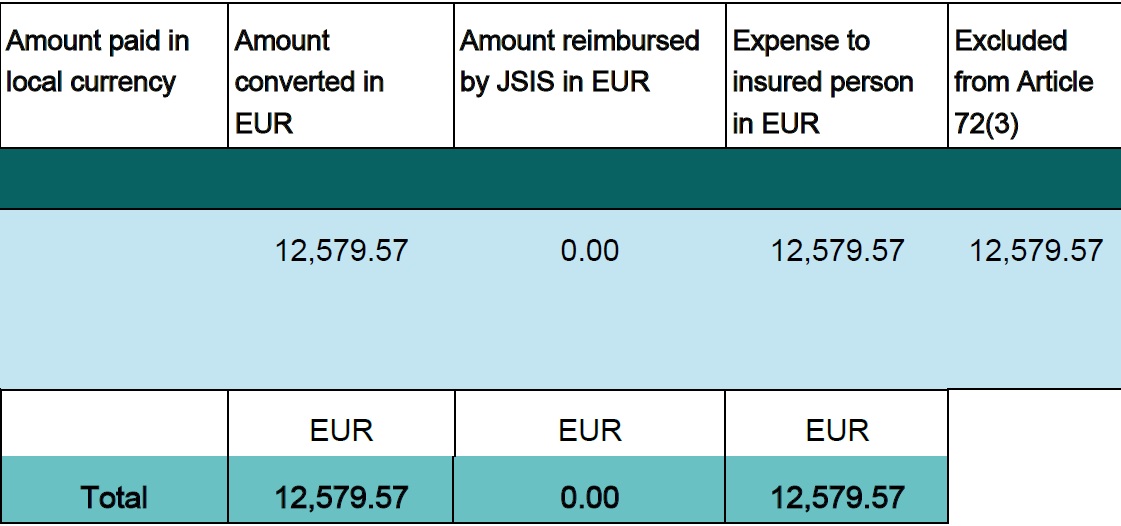
First things first: exhaust points 1-3 (below) as soon as you can, while remembering that the clock is always ticking on the deadline.
- Check the reimbursement account sheet itself: page 1 will contain a code with a generic explanation (‘Statement message’) of what is believed to be missing.
- Follow the instructions for the corresponding statement message, even if the requested information was already present (but perhaps unclear) in the original reimbursement request.
- If you still get a negative response submit a review application by any of the following means:
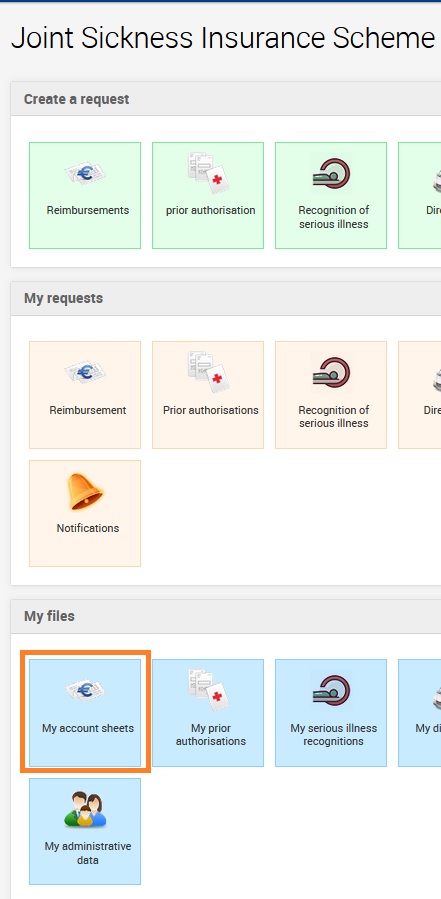
- JSIS online>My files>My account sheets and the bubbles [2]: this opens a pre-filled staff contact query.
- Phone: *03.03.2024: the contact number listed on p.2 of the account sheet is out of date* Phone lines and hours are listed here.
- On paper to your settlements office.
- in-person visit (normally by appointment) to the settlements office.
- If you are still getting refusals after supplying all of the requested evidence then, as per page 2 of the reimbursement sheet, the next step is a formal complaint: Article 90(2).
- If your Article 90(2) complaint is refused then the only remaining option is legal action which may be prohibitively expensive. Nevertheless here is a case from the Parliament where the colleague won.
Illnesses or treatments which are not recognised or reimbursed via the JSIS
Unfortunately, this does indeed happen and here colleagues have an enormous additional burden, as was the case for the Parliament colleague above. Sometimes a treatment or expense is covered under national systems but not under the JSIS[3]. The latest examples we have of incomplete or partial recognition only are with long Covid and attention deficit hyperactivity disorder (ADHD) in adults: colleagues have had to do a huge amount of paperwork to exhaust all possible routes for reimbursement for each prescription.
Making informed decisions
The mediation service is also a possibility: they are experienced in dealing with these types of disagreements. Some 27% of all the disputes they addressed in 2022 were related to financial rights and obligations. Nevertheless, the time spent in mediation risks running down the clock on the submission of a formal complaint, since the two cannot run concurrently.
And the story above? Explain ‘solved’!
The non-emergency category C2 orthopaedic surgery above was reimbursed at 84% after submitting a much (much, much) more detailed bill[4]. This still left a significant part for the individual to pay (the prices shown are from 2014). Please consider complementary insurance to cover these events (as the colleague had already done in this case: phew!) Complementary insurance cannot, unfortunately, be purchased retrospectively.

Additional info
- Special reimbursement might be a possibility where ‘your medical costs have already been reimbursed, but the cumulative costs that you have had to meet yourself (usually 15% or 20%) exceed half of your average basic monthly salary (or pension) over a 12-month period.’
- Direct billing might be possible if the hospital agrees to work with the Commission directly to have the bills paid. Note that not all hospitals are happy to accept this. (e.g. one colleague’s request was refused by a private hospital in the UK in 2014 (threat to cancel surgery if not paid in full and in advance)).
- It is now (finally) possible to modify an already-submitted claim on the day of submission (e.g. you’ve forgotten to attach the evidence or put in the wrong currency).
- 18 month time limit:
Please don’t get stuck! If you can find someone who has been through something similar and is willing to share their adventure with you then this can be incredibly useful. Ask colleagues for help. If you get stuck, you can even ask us!
We’re here for you!
If you appreciate our work, please consider becoming a member of Generation 2004.
[1] 2-months for seconded national experts (SNEs)
[2]

[3] This is the case for e.g. adapting a home to accommodate a disability in Luxembourg. In the institutions there is a budget available for this but it is not done via the JSIS. Check it out: ‘Non-medical expenses … equipment such as stair lift, or a ramp, software …’. Requests for adapted IT equipment would be dealt with between My IT support and the Medical Service and for furniture also.
[4] Part of the issue was that this was a package price: it was possible to stay in hospital post-surgery for 3, 4, or 5 days, as needed. There was no discount for staying only 3 days and no additional payment required for staying 5. Consequently, it was not possible to give a price for each night in the hospital. RCAM required that each item have a set price and the hospital refused to give a price to something which was flexible and part of a package. Enormous thanks again to the PMO colleague who said the magic phrase ‘leave it with me’ and who managed to find a way to make this work!
