 The recent judgment from 13 May 2026 (Case C-155/25, Commission v Italy) of the Court of Justice of the European Union deserves particular attention from an EU staff perspective. It shows a striking contradiction in the Commission’s approach to fixed-term employment.
The case concerned the misuse of successive fixed-term contracts in the Italian public education sector, and the Court confirmed that Member States must take effective measures to prevent the abusive use of such contracts where they are used to meet needs that are, in reality, permanent.
What makes this judgment particularly striking for Generation 2004 is that it was the European Commission itself that brought the case against Italy.
We fully support the principle that fixed-term contracts should not be used indefinitely to cover permanent staffing needs. But we also believe that the Commission should apply the same logic within its own administration and lead by example.
What did the Court say?
The case concerned administrative, technical and auxiliary staff in Italian public education establishments who were employed through successive fixed-term contracts.
The Commission argued that the Italian system failed to provide sufficient safeguards against the abusive use of successive fixed-term contracts.
The Court agreed.
It found that the Italian framework did not provide an adequate maximum duration or sufficient limits on successive temporary contracts. It also noted that the system could encourage the continued use of fixed-term contracts even where the underlying staffing needs were not genuinely temporary, but permanent and long-term.
The Court stressed that national rules cannot be justified by the need for flexibility if they allow successive fixed-term contracts to cover staffing needs that are actually permanent.
This is a powerful principle.
And what happens inside the Commission
Here is where the situation becomes difficult to reconcile. The Commission regularly argues –quite rightly – that employers should not use successive fixed-term contracts to cover permanent needs. Yet inside the Commission, many colleagues work for years under non-permanent contracts, performing tasks that are clearly ongoing, permanent and essential to the institution’s activities.
The current framework creates a paradox. Colleagues can be employed through different types of non-permanent contracts, sometimes accumulating several contracts and years of experience, while still having no predictable pathway towards stable employment.
Unjustified multiplication of non-permanent contracts
The Commission uses different forms of non-permanent contractual arrangements, including Contract Agents, temporary agents and interim staff. We believe that these forms of employment should only be used when strictly necessary and properly justified.
In fact, apart from the different conditions, including remuneration, that govern each category of staff, in many cases there appears to be no real distinction in the nature of the tasks they perform. The distinction between the different categories seems to exist largely on paper, while the work actually carried out is often very similar to responsivities carried out by permanent staff.
This raises the question of whether the multiplication of non-permanent contracts, and the extent to which they are used, is genuinely justified. Indeed, around 36% of the Commission non-managerial statutory staff are employed on non-permanent contact: 26% as Contact Agents and 9.9% as Temporary Agents (see the backdown below). Are these proportions not excessively high?
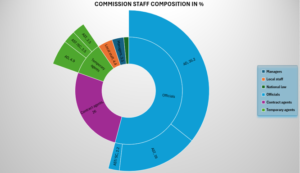
Source: Based on HR Key Figures dashboard (1st January 2026)
The Court of Auditors special report (from 2024) on the EU Civil service revealed that the Commission had the highest absolute number of temporary staff on permanent posts compared to other institutions. The EAC considers such reliance on temporary staff a potential risk to business continuity, particularly where temporary contacts are used to perform functions that correspond to permanent posts.
Shouldn’t the Commission instead strive to provide permanent services on the basis of permanent staff, while using non-permanent arrangements only where there is a genuine and clearly justified temporary need?
That goes without saying that colleagues already engaged on non-permanent positions should not be affected by a potential decrease in the recourse to non-permanent staff and offer possibilities to move to more secure employment, especially if justified by the permanent nature of their responsibilities.
Statutory non-permanent arrangements
For Contract Agents under Article 3b of the CEOS, the Commission applies specific limits on the duration of employment. Generation 2004 has repeatedly highlighted the consequences of these restrictions: colleagues can build up years of experience and institutional knowledge, perform essential work and receive positive assessments, only to face the end of their employment because of contractual limits.
Generation 2004 has been raising this issue for years. The result is a system in which the institution loses experienced colleagues precisely when they have acquired the greatest knowledge of their work.
Generation 2004 has been particularly critical of this approach. We have argued that contract agents should have clearer and more sustainable career paths. One of the options would including possibilities to move into Temporary Agent positions and ultimately permanent employment. Such an approach could work if appropriate pathways to permanent employment through internal competitions. Contract agents currently face too significant regulatory restrictions when it comes to accessing internal competitions and subsequently being appointed as officials.
Similarly, temporary agents may be engaged under different temporary-agent contracts, sometimes consecutively or in combination, whether in the interest of the service or for other reasons. In this way, colleagues acquire valuable experience and institutional knowledge, yet the institution does do enough to capitalise it and offer them long-term employment security.
But the issue does not concern only statutory staff
The principle raised by the Court is also relevant when looking at the situation of interim arrangements.
Such arrangements are sometimes prolonged for extremely short periods – sometimes only one week at a time – for months or even years.
While interim staff are not statutory staff, the institution regularly relies on their services. When such contracts are repeatedly extended in this way, it additionally normalises precarious employment arrangements and unequal treatment within the institution.
A one-week extension may make sense where there is a genuinely short-term operational need. But when the same arrangement is repeatedly renewed over a long period, it is legitimate to ask whether the contractual solution still reflects the reality of the staffing need.
This is particularly important for colleagues who may spend years contributing to the work of the institutions, acquiring expertise and performing functions that remain necessary, while their employment remains subject to continuing uncertainty.
Do we really need to rely on interim staff in this way? Shouldn’t colleagues instead be engaged under appropriate statutory non-permanent arrangements where the needs are genuinely temporary, and under permanent arrangements where the needs are of a permanent nature?
The judgement and the Commission reality
Of course, the legal framework applicable to EU staff is different from that applicable to national public administrations. C-155/25 does not automatically give EU staff a right to a permanent contract, nor does it directly govern Temporary Agent or interim contracts.
But the underlying question remains highly relevant:
If the work is genuinely temporary, why does the need continue for months or years? And if the need is permanent, why should the employment relationship remain permanently temporary?
The irony is difficult to ignore
There is an obvious irony here.
The Commission tells a Member State that it cannot use successive fixed-term contracts to cover permanent staffing needs, while at the same time maintaining a system in which colleagues may spend years performing continuing work under non-permanent arrangements and then be forced to leave because of contractual limits.
Again, we are not claiming that the legal situations are identical. They are not.
But the principle is the same: temporary employment should correspond to a genuinely temporary need.
If the Commission considers this principle important enough to take a Member State before the Court of Justice, it should also be prepared to reflect on how that principle is applied within its own administration.
We need consistency, not double standards
Generation 2004 believes that the Commission should take a close look at the message contained in its own litigation.
If successive fixed-term contracts are problematic when they are used to cover permanent needs in national public administrations, the Commission should be prepared to examine whether its own employment model creates similar problems in practice.
We have reached to the administration to acquire how the Commission plans to recognise the principles of this judgement in its own reality? Please see the note under References at the bottom of this article.
We are not suggesting that every Contract Agent, Temporary Agent or interim worker should automatically receive an indefinite contract. Recruitment rules, budgetary constraints and the specific legal framework of the EU institutions must of course be respected. But the way the current workforce is deployed should evolve. There should be a much stronger link between the genuine and continuing needs of the service and the employment status offered to the colleagues performing that work.
Where a job is clearly permanent, where the colleague has demonstrated their value over several years, and where the institution continues to need the work, simply replacing the person or repeatedly extending their contract for very short periods is difficult to justify from the perspective of business continuity, retention of expertise and good administration.
Commission should lead by example
For Generation 2004, this judgment is therefore more than an interesting development in EU labour law.
It is an opportunity to ask a straightforward question:
If the Commission believes that permanent needs should not be covered indefinitely by temporary contracts in Member States, shouldn’t the same principle apply to the Commission itself?
We believe it should.
The Commission should not merely ask others to follow good employment principles – it should lead by example.
That is why Generation 2004 continues to advocate for more sustainable careers for Contract Agents and Temporary Agents, better transition opportunities, more frequent internal competitions and genuine pathways towards stable employment.
These are not only questions of fairness for individual colleagues. They are also questions of institutional memory, efficiency, continuity and the responsible use of public resources.
The Commission should not lose experienced colleagues simply because the contractual framework says that their time is up – especially when the work itself clearly is not.
Share your experience
If you are a Contract Agent, Temporary Agent or colleague working through an interim arrangement and are concerned about repeated short-term extensions, contract duration, renewal prospects, career options or access to internal opportunities, Generation 2004 is here to help or clarify what is currently possible. Additionally, your direct contributions give us the context to continue raising these issues and pushing for a fairer and more sustainable employment model across the Commission.
References:
Generation 2004 note of 31 August 2026 to DG HR on the application of the principles of the CJEU judgment on successive fixed-term contracts
