 If you’re facing a problem at work, have a question about your rights, or need help navigating a difficult situation, you don’t have to go through it alone. Staff representatives are here to listen, guide, and support colleagues regardless of staff category or contract type. Being a staff representative means more than attending meetings.
It means being visible, accessible, and actively defending colleagues’ rights across all categories and sites. Whether you are in Brussels, Luxembourg, Ispra, or elsewhere, the issues may differ, but the goal is always the same: ensuring a fairer, more transparent, and inclusive workplace.
Every year, our colleagues at Generation 2004 deal with hundreds of individual cases – from questioning reimbursements, to contesting unfair reports, to clarifying pension rights, or defending fair promotion and reclassification decisions. Last year alone, this meant 981 cases of support and legal aid, ranging from contract issues and competitions to working conditions and rights with PMO.
These numbers show that representation is not abstract: it has a direct impact on colleagues’ daily working lives.
How it works
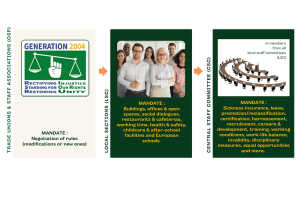
Staff representatives are first elected to their own Local Staff Committee (LSC), which is one of eight. Their role is to represent colleagues at their specific site, addressing local working conditions, office organisation, and practical day-to-day matters. There are LSC elections every three years.
| Local Staff Committee | Last elections | recent/upcoming elections |
| Luxembourg | December 2022 | December 2025 |
| Petten | March 2023 | March 2026 |
| Ispra and Seville [*] | November 2024 | November 2027 |
| Karlsruhe | December 2024 | December 2027 |
| Outside the Union (CLP-HU) | March 2025 | March 2028 |
| Brussels | March 2025 | March 2028 |
The role of the staff representatives is to represent colleagues at their specific site, addressing local working conditions, office organisation, and practical day-to-day matters.
Some of these representatives are later chosen to participate (‘delegated'[**]) to the Central Staff Committee (CSC), where representatives from all 8 LSCs come together to work on Commission-wide issues that affect all staff, such as HR strategy, promotions, working time and major reforms. So, for example staff representatives from all LSCs worked together to ensure that the Commission Decision on working time and hybrid working (WTHW) included e.g. a disconnect period and (paragraph 7, page 2) and a potential reimbursement for teleworking costs (Article 13.4).
Key areas of work include:
- Working conditions: Representatives defend fair and balanced working conditions. This includes pushing for equal access to internal competitions, fair workload, and the protection of acquired rights in reorganisations.
- Transparency: Staff representatives must ensure colleagues stay informed. This includes the availability of formal minutes from LSC and CSC meetings, where applicable, as well as informal communication via newsletters or short updates. Sharing key developments helps build trust and keeps colleagues engaged with the work of their representatives. In many cases, representatives also share the notes they send to the administration (whether that’s via Generation 2004, the relevant LSC or the CSC) and the replies received. These efforts ensure that staff are aware of what is being discussed and defended on their behalf.
- social dialogue: Staff representatives play an active role in negotiating key policies with the administration. This includes participation in formal concertation[**] and, when needed, conciliation[**]. They work on strategic topics such as geographical balance in recruitment, mobility for staff, the decision on temporary agents, working time rules, hybrid working conditions, and broader HR reforms. Through this dialogue, they help shape the future of staff policy at the Commission.
- Representation system: While not all sites are actively working on reform at the same time, staff representation regularly raises questions about how elections are organised and how tasks/committee membership/roles (‘mandates’) are allocated. Topics such as proportionality, clarity of rules, and fair access to joint committees often come up in electoral programmes. Another concern is that electronic voting is not yet available at all sites, which may affect inclusiveness and turnout. In addition, elections are held at different times across Commission sites, which leads to a constant state of campaign activity and complicates coordination between local and central bodies. We support the idea of synchronising elections and modernising the system to ensure greater fairness, transparency, and efficiency.
- Support to individuals: Staff representatives assist colleagues throughout their careers. This includes explaining how the promotion and reclassification systems work, organising information sessions, and helping to draft self-assessments or appeals in cases of non-promotion. They also support colleagues in preparing and submitting complaints or requests under Article 90 of the staff regulations, when needed to defend their rights. Representatives provide guidance during disciplinary or administrative procedures, ensuring fairness and proper process. In some cases, they assist with or coordinate legal action, particularly when a larger group of staff could benefit. A recent example includes the successful support for JSIS reimbursement of fertility preservation treatments (freezing). Whether personal or systemic, staff representation is there to help colleagues navigate the process and defend their rights.
- Defending underrepresented and vulnerable groups: Staff representatives ensure that no group is forgotten or left without a voice. This includes colleagues in smaller sites as well as those in less-favourable working conditions, such as Contract Agents, temporary staff, those on short-term assignments, those asking for reasonable accommodations, those recruited post-2014 or those who see their function group disappearing. While not always small in number, these colleagues often face a mixture of reduced rights, weaker job security, or barriers to career progression. Staff representation works to highlight these inequalities, defend their interests, and push for lasting improvements: wellbeing is for all of us!
Why does it matter?
Because the workplace is changing quickly. The shift to telework, office restructuring, and now the upcoming large-scale review of the Commission: all of this directly affects how we work, how decisions are made, and how our rights are applied. Without active, informed, and committed staff representation, these changes risk happening without meaningful staff input.
Standing as a candidate in an LSC election is about so much more than holding a title.
It means being ready to:
- Listen to colleagues,
- Act on their concerns,
- Defend their interests consistently,
- Speak up when needed and follow up to ensure results.
If you are willing and able to stand for election:
Be visible. Be present. Be accountable.
If elected:
Stay consistent. Listen to all. Represent fairly.
Generation 2004 believes in a model of staff representation that is practical, inclusive and independent without drama or elitism.
Whether you are working at the local level or contributing to central committees, your voice matters. Whether you vote, run as a candidate, or simply reach out with your questions – your involvement strengthens staff representation. Because ultimately, it is not just about representatives: it is about all of us, building a fairer workplace together.
Let’s raise the standard together.
Become a candidate in the upcoming elections, your colleagues need your voice:
Luxembourg LSC – November / December 2025
Petten LSC – March 2026
EEAS staff committee [***] – March 2026
If you’re not sure who your staff representatives are, you can usually find them listed on your site’s Staff Committee intranet page or by checking the staff representation in who is who.
As always, if you have any questions or comments, feel free to contact us!
If you appreciate our work, please consider becoming a member of Generation 2004.
[*] Neither one site, nor ‘local’, the staff committee is shared even though the sites are in different Member States, more than 1000km distant and often have very different issues to discuss.
[**] The learning curve can be a little steep at first due to the specific terminology and how it’s used.
[***] A stand-alone staff committee in Delegations which is not one of the 8 Commission LSCs.
