 Advancement opportunities for Contract Agents (CAs) are often perceived as limited. Various mechanisms for career progression exist, but they differ considerably in terms of accessibility. Some are automatic, some require significant effort, some depend on available resources, and others are subject to restrictions that make them far less accessible in practice than they appear on paper.
For CAs, understanding these distinctions is essential. It helps to manage expectations, but also to make informed decisions when considering career opportunities within or outside the Commission. Knowing what is possible, what is realistic, and what may require considerable patience or effort is often as important as the opportunities themselves.
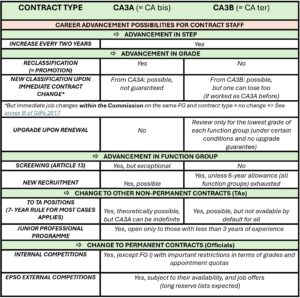
Steps and Grade Advancement
When recruited as a CA, you are assigned a function group, a grade, and a step. These determine your basic salary.
For most CAs, advancement possibilities within the grade structure are limited. Apart from CA3As, who are subject to reclassification exercises and a small number of exceptions concerning certain CA3B colleagues, most colleagues remain in the same grade throughout their career as CAs. In practice, this means that while salary progression exists, it is largely linked to advancement in step rather than advancement in grade.
Advancement in step is automatic and takes place every two years.
There are several situations where colleagues should pay close attention to the potential consequences for their classification and future salary progression. Transitions from CA3A to CA3B and then back to CA3A, situations where a colleague accepts or changes a contract at a wrong or premature moment in time (to qualify for a meaningful classification review); or the failure to provide adequate documentary evidence of recruitment can all affect future classification and remuneration.
These are issues that may appear technical, but they can have lasting consequences. An incorrect classification at recruitment or a poorly understood contractual transition may affect a colleague’s salary progression for years. This is one of the reasons why understanding the classification rules is so important.
We have explored grades and steps in much greater detail in one of our previous articles.
Increase in Function Groups
Function groups are intended to reflect the nature of the tasks performed and are linked to specific educational requirements. In reality, however, the distinction between function groups is not always as clear as the rules would suggest.
We increasingly observe CAs being entrusted with responsibilities that extend beyond what might traditionally be associated with their function group. In reality you may be performing responsibilities which may touch upon adjacent functions groups, but your core tasks should be linked to the actual function group. We see more and more responsivities given to contract agents.
CA3As FG III are given Authorising Officer by Sub-delegation (AOSD) roles, now allowed by the Internal rules. We have also seen FG I and II having formal or informal staff supervisor tasks…
Move to another function group within the Commission?
Yes, this would be possible. However, in most cases this requires a new recruitment procedure. In practice, this means participating in a selection procedure, often alongside external candidates, and successfully completing a probationary period.
According to information received from DG HR, such cases among CA3B colleagues are not negligible. This is good news. We refer in this respect to the reply received on 19 June 2026 to one of our notes (published under References below). We intend to request further statistics on this issue. It is important to note that the so-called screening exercise does not apply in such situations. A standard recruitment procedure takes place.
While a move to a higher function group generally results in higher remuneration, colleagues should be aware that the salary scales of neighbouring function groups overlap. The highest grades of a lower function group may correspond to salaries comparable to those of the lowest grades in the higher function group. Furthermore, the recruitment grades established under Article 5 of the GIPs effectively limit access to the higher grades within a function group.
In the specific case of an immediate transition from a CA3A contract to a position in a higher function group, there is nevertheless an important safeguard. If the classification resulting from the application of Article 5 of the GIPs would place the colleague in a less favourable position, the previously held grade and step should be preserved. This safeguard does not exist if you move from a CA3B contract. See annex III of GIPs 2017 for more details.
MOVE to a Higher Function Group Through an Internal Procedure?
Such a possibility exists through the so-called screening exercise.
The screening exercise is reserved for CA3As and allows movement to a higher function group without the need to undergo a standard recruitment procedure. However, despite its existence in the rules, the exercise remains largely underutilised.
At present, the exercise is irregular, lacks transparency, and is not supported by clearly established quotas. Although the relevant provisions describe it as an exceptional mechanism, in practice it has become so exceptional that many colleagues may never have a realistic opportunity to benefit from it.
The fact that the exercise is linked to the availability of financial resources further contributes to its limited use. This is particularly regrettable given the situation of many CA3A colleagues, who often face restricted mobility opportunities, lengthy waiting periods for reclassification, and limited prospects for career development.
We believe that the screening exercise should become more regular, more transparent, and more accessible. This position is consistent with our broader proposals concerning the renegotiation of the 2017 GIPs. It is also one of the key demands put forward by the CA Collective, whose objectives we support.
Change to Other Non-Permanent Positions
Another possibility for career development is through selection to other non-permanent staff categories, i.e. temporary agent (TAs) positions.
A CA3B career may be combined with service as a TA. This possibility exists but is not guaranteed. It is also here that the so-called 7-year rule becomes particularly important.
In simple terms, a person may work under non-permanent contracts in the Commission, combining for example CA3B and TA service, for a maximum of seven years within a twelve-year period. A typical example would be a colleague serving six years as a CA3B and then one additional year as a TA. After spending five additional years outside these categories or under a different type of contract, it may be possible to return.
In principle, a returning colleague may have a contract typical to a different non-permanent staff category or type, otherwise they can only use whatever entitlement remains still available under the relevant contract / staff category. For example, article 88 of the CEOS establishes a maximum cumulative duration of six years for service as a CA3B. This limit applies throughout a colleague’s entire career, regardless of any changes in function group. As a provision of superior legal authority, article 88 CEOS prevails.
We believe that the current framework unnecessarily limits career development opportunities. Extending the 7-year rule would facilitate TA transitions (if not guarded by the interest of the service). This is particularly important because TA status provides by far much broader access to internal competitions and easier appointment to a permanent post. CAs face significant limitations in this regard.
We have advocated for such changes for some time. Encouragingly, the discussion has recently returned to the central level and was among the issues raised by the Central Staff Committee in its contribution to the Large Scale Review.
Change to Permanent Positions
The path towards a permanent position remains through competitions.
These may be external EPSO competitions or internal competitions organised within the Commission.
In theory, these routes are open to all, in practice, however, colleagues face a range of obstacles. Difficulties within the EPSO system, lengthy competition timelines, delays compared to the planning; concerns regarding testing methods, the limited number of internal competitions, their exceptional character for CAs and various regulatory restrictions for CAs all contribute to making this route considerably more difficult than it may initially appear.
As a result, while access to permanent positions although remains possible, for the majority of contract agents this is often easier said than done.
Conclusion
One of the recurring challenges faced by CAs is the difference between what is theoretically possible and what is realistically achievable.
Looking solely at the rules, numerous advancement possibilities appear to exist. Reclassification, movement between function groups, screening exercises, TA appointments, and competitions leading to permanent positions all form part of the framework. Yet, each of these mechanisms is accompanied by conditions, limitations, waiting periods, budgetary constraints, recruitment procedures or practical obstacles that significantly affect their accessibility.
This does not mean that advancement is impossible, but colleagues should understand not only what opportunities formally exist, but also how those opportunities function in practice.
This is precisely why we continue to analyse these issues and explain them in detail. Our objective is not to create unrealistic expectations, but rather to ensure that colleagues have a clear understanding of the rules, their rights, the available opportunities, and the limitations they may encounter along the way.
Being well informed is key. We want colleagues to understand the system as it actually operates, not simply as described in theory. Better information enables better decisions. It allows colleagues to assess opportunities realistically, plan their careers more effectively and avoid the frustration that often results from incomplete information.
References:
Generation 2004 reaction note of 25 June 2025: Classification in grade of CA3Bs – request for additional clarification
DG HR reply received on 19 June 2019: Reply to the note on the application of article 5 of GIPs
Generation 2004 note of 13 May 2026: Classification in grade of CA3 – application of article 5 of C(2017)6760
