 Generation 2004’s first assessment of the High-Level group report on the Future of the Commission’s civil service.
The High-Level reflection group chaired by Catherine Day has published its final report, “The Future of the Commission’s Civil Service”. It is an external, “outside-in” contribution to the Commission’s large-scale review (LSR), and it will feed into the report that Commissioner Serafin is due to present to the President and the College by the end of 2026. We have presented our first assessment directly to the Commissioner, in a constructive meeting on 13 November 2026, held in the spirit of social dialogue, and these are our considered views.
The time available was limited, yet the Commissioner allowed the discussion to run a little longer so that staff representatives could be heard, which we appreciated. Out of respect for that dialogue, we do not pre-empt here the report the Commissioner is preparing; we set out our own position. This article is the developed version of our position and additional points we were not able to raise in the meeting. The high-level report sets out a package of recommendations from a group of nine external experts. Its central message is that the status quo is “not a real choice” and that the Commission must become faster, more flexible, and more able to adapt. Among other things it proposes greater role for the Secretariat General as a pole of coordination. On careers and recruitment models, it recommends opening senior and other posts to external candidates, a more flexible mix of permanent and temporary staff, far greater use of artificial intelligence, a central pool of posts that would no longer “belong” to a single department, a drive to “stop doing” lower-value tasks, and a review and consolidation of the agencies. The group is clear that it sees these as a single package and warns against picking only some of them. Our position was clear: before opening posts to the outside candidates, we recommended to open real and transparent career prospects and career developments to the staff already inside the institution and ensure talent retention.
We share some of the starting points, and we welcome the idea that leaders should foster psychologically safe environments that encourage staff to challenge, experiment, and express constructive dissent. The world is changing, the institution must adapt, and we are not here to defend the status quo. But a report with recommendations about the future of tens of thousands of colleagues has to be judged on what it means to them, and this needs our critical assessment.
We find the last part of the 4th recommendation on AI, that every member of staff should be equipped with an AI assistant and be answerable for the work produced in their name by the AI, particularly worrisome. There should be clarity on such recommendations that the accountability stays with the institution that deploys the AI tools, not with the staff as a user. How can staff be expected to ensure the quality of the AI output, since the human brain does not have the cognitive capacity of AI, not to mention that staff is not behind the development of the AI tool to ensure that it is developed in alignment with the human values, ethically and safely? We recommended that the rules on liability and the AI governance should be settled before deployment and not after. For that purpose, we also requested the setting up of a joint committee on AI and innovation that we esteem necessary to oversee the use of AI and ensure the needed guarantees and safeguards for the staff.
For a real modernisation of the Commission: with the staff and also for the staff
For a group of nine senior experts, we had hoped for fresh thinking built specifically for the Commission. Instead, there is very little that feels new. The report is abstract on management, with more than twenty references to the OECD, an OECD official sitting on the group, and a benchmarking exercise whose briefs were prepared by Gartner and the OECD. Much of it reads as a set of general ideas that could be applied to almost any administration, rather than proposals grounded in the Commission’s own reality. The Commission cannot simply be compared with OECD, as these institutions have different frameworks, competences, and functions. Consequently, the Commission’s benchmarking should ensure specific key performance indicators to reflect its own realities. That benchmarking itself is a good example of a wider transparency problem. It is presented as a key input that will feed the Commissioner’s final report, yet not a single result or method is published, and when we asked for the details on the sources or the benchmarking exercise, they were not shared with us. If an external benchmarking exercise is helping to shape the future of the EU Commission and its civil service, staff and their representatives are entitled to see what it actually assessed, including the basis of assessment, and the conclusions.
Our central concern, though, is the staff and whether they will have sufficient capacity to fulfil the new roles expected of them. We wonder if double standards are used in this modernization process, since the aspect of capacity building does not seem to have be taken into account at all, although the Commission introduced Administrative Capacity Building Roadmaps as strategic and operational tools to be developed by the EU Member States within the 2021-2027 MFF. The report points towards a more temporary and “flexible” workforce and would open posts to external candidates, while saying almost nothing about the staff already here or about their internal career paths. For colleagues who have already struggled to progress, and in particular for AST and AST-SC colleagues and for contract and temporary agents, this is a real threat. It also puts internal competitions at serious risk, at the very moment when they should be strengthened. Additionally, the report does not take into account the effects of the VUCA (Volatile, Uncertain, Complex and Ambiguous) environment on the way in which the Commission now functions, leaving out again, the mental health aspect promoted since October 2026 as a shared responsibility by the Commission, outside of the Commission.
Working conditions and mental health left out
Although mental health is considered a shared political priority across all EU policy domains by the Commission since 2023, the report leaves this out. The effects of the new normal working rhythm used in the Commission, where the expectation is to do more with less while functioning in survival mode, jumping from one crisis after another, are again left out. The white elephant is ignored because there are plenty of people that can be burned through temporary low paid contracts and double standards. New skills from outside are welcome, but the answer is to invest in the human capacity of the staff, to combine the experience of long-serving colleagues with new ideas, not to replace one with the other. An effective and efficient administration depends on its people. A Commission built increasingly on temporary staff is a Commission that loses its sustainability, its institutional memory. Constant rotation and turnover carry a real cost in the quality and continuity of the work. This is not only our view: the European Court of Auditors warned in its 2019 report, Special Report 15/2019 on the 2014 staff reform, that relying on temporary staff carries real risks for business continuity and knowledge management. The report pushes in exactly the direction its own sources caution against. Such changes would directly affect the EU Civil Service and the staff regulations. Our position and recommendations are that the measures should stay within the current Staff Regulations; a permanent civil service remains the core strength of the European Commission.
Selective use of evidence
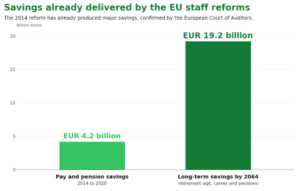
What strikes us most is how selectively the report uses the evidence. It refers to the European Court of Auditors only once, and only to support reshaping the agencies, while staying completely silent on the Court’s findings that do not suit its argument. The Court found that the 2014 reform had already delivered major savings, around 4.2 billion euros over the 2014 to 2020 period and around 19.2 billion euros in long-term savings, and it warned that going further would damage knowledge retention and business continuity. It also recommended assessing the real needs and impacts before any further change to the Staff Regulations. Staff have already paid, through two reforms, over many years.
Review and consolidation of the agencies
The report is also strikingly vague about the agencies. It counts 35 decentralised agencies with a budget of 3 billion euros a year and over 15 000 staff, six executive agencies with a combined budget of 420 million euros and 3 305 staff, and six Offices with an annual budget of 395 million euros and 3 380 staff, and it calls for review and consolidation. Behind those figures are thousands of colleagues who deserve to know what consolidation would actually mean for them, and on that the report is silent.
A budget-driven exercise
We see this reform including the recent report, as a budget-driven exercise. We put that point to the Commissioner directly. Reading the report together with the proposed cuts to the next MFF, we see this exercise as more than modernisation alone. The direction is also not really a surprise, because the chair of the group had already stated publicly that the Commission should recruit people “maybe not for lifetime employment”, a remark she subsequently said was misquoted. We understand, of course, that we are living through a genuine technological change and that the institution has to prepare for it. But we are worried as the arrival of artificial intelligence cannot become a mere justification for changes like cutting posts or redeploying people without safeguards. Technology should be used to support staff in their work, with proper assessment of its effects on them, not as a reason to reduce the workforce. Staff needs predictability and proportionate safeguards.
We also recognise that budgetary pressure is real, and that is precisely why a report like this should offer concrete and actionable recommendations rather than general ideas. If savings genuinely have to be found, let us find them in the right places: in simpler processes, less duplication and more transparent and faster recruitment and certification, rather than in cutting posts or careers for colleagues, to ensure a real simplification for the staff and with the staff. Generation 2004 is ready to engage constructively on how to make the institution more efficient. What we cannot accept is that the savings are achieved at the expense of the very people who deliver the work.
Future perspectives
The way forward, for us, is straightforward:
- The Commission should invest and retain the talent it already has: this is a real option by using strategic tools such as the ones pushed onto the Member States in the previous MFF (Administrative Capacity Building Roadmaps) and build real, transparent internal career paths and career developments, instead of looking for people outside. It should build on the cross-category internal competitions introduced last year, which are a welcome step, and open up genuine, lasting career prospects for AST and SC colleagues, ending the career blockage they have faced for too long. It should also offer contract and temporary colleagues a stable and fair route rather than more precarity.
- The benchmarking report or recommendations should be published in full, so that staff and their representatives can see the evidence that is shaping their future.
- On governance, a stronger centre must not come at the expense of transparency, accountability or professional autonomy. If portfolio teams will be created, staff must have clarity on the leadership, reporting lines, workload, evaluation and real recognition. Cross-DG working together needs clearer governance structures and fair HR procedures, with clear planning and transparent overview in all processes.
- As regards AI and innovation, firm and concrete safeguards are needed for the staff.
- On culture change and leadership, the Commission must ensure a working environment built on trust, ensure psychological safety at all levels and have leaders with people skills that build trust and create the needed conditions for sustainable performance and staff development.
- Working conditions, including teleworking conditions, should be further addressed to ensure the Commission remains attractive and offers competitive and modern working conditions for all staff.
- Crucially important, this large-scale review can and should be done under the current Staff Regulations. We hold the Commissioner to his repeated assurances that they will not be reopened.
- We expect the permanent European civil service to be protected and staff representatives to be genuinely consulted at every stage of the process, including in the implementation phase, rather than this being run as a top-down exercise.
We will raise these points directly at our next meeting with Commissioner Serafin, and we will seek the opportunity to put them forward to Catherine Day and her group. We will keep members informed as the Commissioner prepares his own report, and we will continue to defend the staff to ensure careers, fair treatment and the quality of the public service that Europe’s citizens rely on.
The Commission now needs not only a vision of change, but also a credible method for delivering it fairly and responsibly. Modernisation will only work if it is built with the staff.
