 After COVID, DG HR carried out ‘pulse surveys’ to get feedback from staff about the ‘new’ ways of working. The latest results from November 2024 (4400 responses) showed that 90% of staff consider that flexible working arrangements facilitate their work, and 86% consider that the flexible way of working suits them personally.
The wellbeing of European Commission staff and a flexible work environment is of great importance for Generation 2004. As DG HR do not seem to be so interested anymore in what staff thinks about flexible working arrangements or teleworking, we launched our own survey on teleworking, teleworking from abroad and travelling to work in July this year.
We would like to thank all 1679 respondents for their participation, and we knew already that this topic is very important to a large number of colleagues.
Teleworking remains one of the most valued aspects of our working arrangements, and recent feedback shows just how important it is for colleagues across the organisation. The comments received reflect strong support for flexible working, while also highlighting a number of concerns about fairness, practical implementation and the impact on staff well-being.
A recurring message is that the current limit of 10 days of teleworking from abroad per year is seen by many as too restrictive. Colleagues point out that this rule can be difficult for those with family ties in other countries, cross-border situations or personal circumstances that require greater flexibility. Several comments suggest that a more generous or adaptable approach would better reflect the realities of a modern, international workforce.
At the same time, many colleagues emphasise that teleworking should remain grounded in trust and flexibility, rather than rigid controls. Feedback suggests that staff appreciate arrangements that allow them to organise their work responsibly while continuing to meet operational needs. For many, teleworking is no longer viewed as an exceptional measure, but as a normal and effective way of working.
Another strong theme is work-life balance. Colleagues describe teleworking as an essential tool for managing personal and family responsibilities, reducing commuting time and supporting overall well-being. In this sense, teleworking is seen not only as a practical arrangement, but also as a contribution to a healthier and more sustainable working life.
Fairness also emerges as an important issue. Some colleagues note that access to teleworking can vary between services, teams or functions, which may create perceptions of unequal treatment. While operational requirements naturally differ, there is a clear expectation that policies should be applied in a transparent and consistent way, with equal consideration for staff in comparable situations.
The comments we received also highlight the need to recognise the diversity of roles and personal circumstances across the organisation. A “one-size-fits-all” approach may not always work. Instead, many colleagues call for rules that allow for a degree of flexibility while still ensuring business continuity and team effectiveness. Meanwhile DG HR issued a new set of indicators in September that measure presence in the office, introducing a Big Brother style of monitoring office presence of staff. For more details, check t Big Brother – Commission office presence: staff deserve trust, clarity and respect (uploaded for comments on 10 November)
For a German colleague working in the European Commission in Luxembourg, with family and friends on the other side of the river Mosel, the increasing demand for more flexible teleworking from abroad is a non-issue. For a Finnish colleague working at JRC in ISPRA, with an old and severely disabled parent in the north of Finland, the need for more flexibility is obvious.
Teleworking is also increasingly linked to the organisation’s attractiveness as an employer. Flexible arrangements are seen as an important factor in recruitment, retention and staff motivation. In a competitive labour market, colleagues believe that modern working conditions can help the organisation remain appealing to both current and future staff.
There is also an important environmental dimension. By reducing commuting and work-related travel, teleworking can support wider sustainability objectives. Several comments underline that flexible working arrangements are aligned with efforts to reduce emissions and encourage more environmentally responsible ways of working.
One colleague is commuting every week from Brussels to Stockholm where the spouse and children live. A very difficult and expensive solution and in this case, there is no other choice. Both the working and private life for this colleague would improve drastically by introducing more teleworking days from abroad.
At the same time, colleagues recognise that teleworking must be balanced with the value of in-person collaboration. Office presence remains important for teamwork, social connection, onboarding and certain types of work. The feedback therefore does not call for a fully remote model, but rather for a balanced approach that combines flexibility with meaningful opportunities to work together on site.
Overall, the message from colleagues is clear: teleworking is widely appreciated and brings significant benefits, but there is room to improve how the rules are designed and applied. In particular, staff are calling for arrangements that are more flexible, more consistent and better adapted to the realities of today’s workplace.
As discussions continue, this feedback offers a useful reminder that teleworking is not just a logistical question. It is closely connected to well-being, fairness, organisational culture and the ability to attract and retain talent. Listening carefully to these perspectives will be essential in shaping future policies that work for both staff and the organisation.
Some findings from our survey
29% of the respondents working in Luxembourg live outside of the country, most of them because it is too expensive to live in Luxembourg.
Most colleagues come to the office 2 days per week, irrespectively of the staff category or country of employment.
Most persons replied that if they could choose and still be able to carry out their work, they would come only 1-2 days per week or only if necessary.
74% of the respondents use the maximum allowed 10 days of telework from abroad, 11% only a few days and 7% do not telework from abroad.
If TWA would be extended to 60 days, the ones who already use this possibility today, would increase the number of days if it was possible
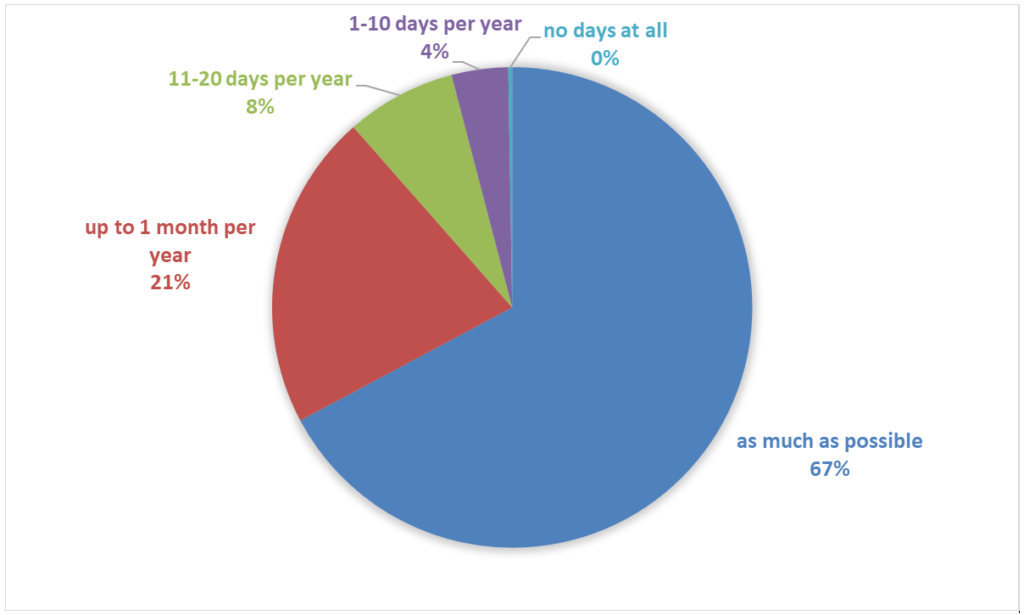
There would be a slight decrease in staffs travelling patterns if they could work more days from another country.
67% of the respondents think that telework in general is not at all or very little limiting personal interaction with colleagues.
83% of them think that teleworking in general is not at all or very little limiting the multicultural spirit in their workplace.
Our colleagues in Malta (and also Luxembourg, Netherlands and Italy) find that their place of employment needs a special arrangement when it comes to teleworking. One main reason that was mentioned by many colleagues is small airports and less travel opportunities compared to Brussels.
Colleagues in Brussels use private cars more than colleagues in Luxembourg for travelling to work. On the contrary, Luxembourgish respondents use their bikes more than their Belgian colleagues.
74% of respondents would postpone their retirement if the working arrangements were more flexible.
Check out our position on flexible teleworking.
If you appreciate our work, please consider becoming a member of Generation 2004
As always, if you have questions, please feel free to contact us.
