 On 12 December 2023, the Commission adopted a new policy on anti-harassment. It repealed the outdated 2006 Commission’s anti-harassment decision (Decision C(2006) 1624/3). Respect, dignity and courtesy are key principles to identify and address harassment and other inappropriate behaviours in the workplace. An Action Plan and a guide for respectful working environment are also part of the strategy to ensure respect at work.
The 2023 anti-harassment policy: a victim-centred approach
The 2023 Commission Decision updates policies regarding psychological and sexual harassment, as defined under Article 12a, paragraphs 3 and 4 of the staff regulations. Also, it should apply to Executive agencies (EA) since 1 October 2025, but its implementation in the Executive agencies is not there yet.
The new policy establishes streamlined procedures and specific means of redress for victims. It is structured in three vectors: (1) a victim-centred approach; (2) early intervention and reporting, and (3) managers as part of the solution. The 2023 Decision standardises processes, emphasizes victim protection, and establishes clearer obligations for managers (Article 21) and staff. It encompasses the obligation to whistle-blow (Article 6(1) and Article 22a of the Staff Regulations (SR) as indicated in Recital 13 of the Decision)) and prevents the risk of intimidation and retaliation (Article 6(4) and 9(3)). The decision includes however a prima facie evidence approach on a case of harassment (formal procedure), which renders, in practice, the victim protection harsh to secure.
Whom to contact first?
On 29 May 2024, Mrs. Lene Næsager was appointed as the Commission’s first Chief Confidential Counsellor (CCC) and took up functions on 1 September 2024. The Commission’s network of 25 confidential counsellors (CC’s) started their work on 6 February 2025.
The CCC role is a key innovation of the new anti-harassment policy. The CCC function however has been designed based on the World Bank’s anti-harassment coordinator model.
The introduction to the first report of activities refers to the function as “a key element of the updated policy”. The CCC plays a pivotal role of the anti-harassment policy on the informal procedure (Article 27): first point of contact for victims; manages a network of CC’s, provides recommendations for interim protective measures and has the right to contact the alleged harasser to express concerns. Exceptionally the CCC may perform the tasks of a confidential counsellor (CC)). The CC’s role is to listen to, support, inform and guide victims. The CC’s must be “neutral” and “objective”. The Commission’s “duty of care” should also require speed, independence, professional distance and clear legal pathways from CC’s and from the CCC.
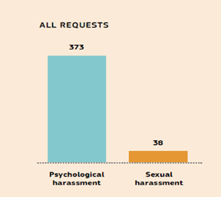
Recently, the CCC signed a Memorandum of Understanding (MoU) with the Commission mediation service (26.02.2025) and a second one with the EEAS mediator (05.02.2026). The EC Mediation Service (MS) is competent for conflicts at work. It acts as “the facilitator between parties in matters related to statutory rights and obligations or in relationship conflicts”. The CCC is responsible for the anti-harassment policy. ‘Psychological harassment’ is a conduct that takes over a period, is repetitive or systematic and involves physical behaviour, spoken or written language, gestures or other acts that are intentional and that may undermine the personality, dignity or physical or psychological integrity of any person. In the first year of the CCC’s office activities, psychological harassment accounted for 373 out of 444 requests received. Sexual harassment, sadly, accounted for 38 requests. There are situations less straightforward (grey area between alleged psychological harassment and conflict at work) where an in-depth assessment is needed to determine where the ‘centre of gravity’ of the case lies. The determination of the ‘centre of gravity’ will define which EC service is consequently competent to deal with the case.
The EEAS mediator addresses and prevents harassment in the Union delegations, but channels must be clearly defined, and approach streamlined to secure a “One-delegation” approach. The recently signed MoU “aims to strengthen the cooperation between the Commission and EEAS in the implementation of their anti-harassment policies”. We understand the ”One-delegation” approach is a “new attempt” to avoid the lack of addressing anti-harassment allegations by staff in delegations. Up to date, the situation is particularly relevant to the staff posted in delegations belonging to EC departments such as RTD, INTPA and FPI. The geographic distance to Brussels also makes it more unbearable when inappropriate behaviour or harassment is being felt by staff. Under the 2023 Decision, except for local agents, there is no restriction to start an informal procedure with the CCC, despite the recommendation referred to in Article 23(3).
The CCC role on the informal procedure will soon be extended to Regulatory Agencies (RA) and Joint Undertakings (JU) by means of service level agreements (SLA’s). This step forward reinforces the role of the CCC as a key actor of the anti-harassment policy at the heart of the EU institutions, bodies and agencies. The extended role offers a compelling confirmation of the wisdom and foresight behind the proposal to establish it in the past – a proposal that trade unions and staff associations advanced together with colleagues from Harassment Watch Network – drawing on the recognised positive experience of the World Bank and on the expertise of the multidisciplinary team of high-level specialists.
First CCC report: bubble of trust?
The first report of activities is out. Its content shows the efforts made by the appointed CCC on the prevention and fight against sexual and psychological harassment in the period from September 2024 to August 2025.
With regards to prevention, between awareness raising and training activities, the CCC was highly active to reaching out to staff by giving many presentations in different departments and EC sites. Jointly mandatory training for managers (728 colleagues) and talks about harassment (8 830 colleagues) covered roughly 10 000 staff members.
Regarding requests made to the CCC’s office (informal procedure), 444 colleagues turning to CCC’s office for assistance in the first year. In 2022 and 2023, fewer than 100 colleagues per year contacted the Confidential Counsellors directly under the scheme in place prior to the creation of the CCC function. In 2022, allegation of psychological and sexual harassment accounted respectively for 7% and 4% of the 40% relationships conflicts. In 2023, the allegation of psychological harassment registered an increase of 15% (from 7% to 22%). No record of sexual harassment. In 2023, the relationships conflicts, compared to 2022, has raised from 40% to 46% (cf. 2022 and 2023 MS statistical information).
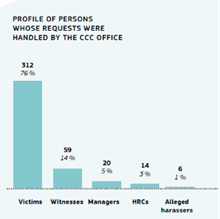
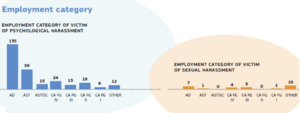
Below some additional data on characterisation of the requests, profile of the requestors and employment category of harassment victims (see annual report, p. 10 to 13)
Against this background, the results of the 2025 Staff Survey indicate a positive effect of the CCC’s office outcome regarding measurement of the new policy to combat all forms of harassment. The 2025 results show a clear and measurable improvement compared to 2024:
- a 7-point increase in the perception that everyone is treated fairly (73%);
- an 8-point increase in the perception that the institution takes the prevention and combating of psychological harassment seriously (54%);
- a 7-point increase regarding the prevention and combating of sexual harassment (63%).
Despite the data provided, the report is lacking information on existing clusters of harassment within the European Commission, particularly by DG and by site. This data is collected by the CCC’s office but was not released. Its disclosure in the next report is relevant to ensure a fully transparent anti-harassment policy and will be an unequivocal confirmation of the CCC’s credibility and whose independence, impartiality, and probity are beyond doubt as referred to in Article 11(3) of the 2023 Decision. This step is needed to secure the bubble of trust.
The weakness of the “victim-centred approach”
The CCC’s office is not competent to assess the factual and legal elements to establish whether there is prima facie evidence of harassment or conclude the establishment of harassment. In a nutshell, the CCC’s office is not entitled to investigate or to judge if a colleague is harassed.
Staff (former) members who consider themselves to be victims of harassment must address their formal allegations of harassment to the Commission by lodging a formal request for assistance (Article 24 of the Staff Regulations (SR)). Alternatively, they, as well as all other categories of persons who are not covered by the SR or the CEOS, may address their allegations of harassment directly to IDOC or to OLAF, without limiting the protection afforded by national law, where available. The evaluation of the factual and legal elements will be done by the Investigation and Disciplinary Office of the Commission (‘IDOC’) and by the DG HR unit in charge of the formal procedure. The unsurmountable point for many potential victims of harassment is proofing the so-called ‘prima facie evidence of harassment’ (i.e. the establishment of factual elements indicating the possible existence of a case of harassment).
The comparison of the action of the CCC’s office regarding the informal procedure achievements in 2024 and 2025 has no correspondence with the output of the IDOC decisions in the same period. In 2024, IDOC reported 3 disciplinary procedures concerning psychological harassment (1 COM, 1 EEAS and 1 EESC). No disciplinary procedures cases relating to sexual harassment. In the same period, 8 cases of inappropriate behaviour (7 COM cases and 1 EEAS case). Sanctions went from grade downgrading to financial penalties (see 2024 IDOC report, p. 9 and 10). In 2025, IDOC recorded 20 disciplinary procedures on psychological harassment (17 COM cases, 6 EEAS cases and 1 EA case. Again, no cases of disciplinary procedures on sexual harassment. In the year, 30 cases of inappropriate behaviour (13 COM cases, 2 EEAS case and 1 EA case) and sanctions went from reprimands to temporarily downgrade (see 2025 IDOC report p. 9 and 10)
By comparing both procedures carried out by CCC’s office and by IDOC and DG HR respectively, the conclusion is self-explanatory, hearing victims without condemning harassers is not protecting the victim. In 2023, the European Parliament in a resolution called for transparency and accountability in cases of harassment, while safeguarding confidentiality and rights of complainants. Also, the EP recalled the “obligation of all of the European institutions to put in place all necessary policies and standardised gender sensitive action protocols to prevent and address all forms of harassment and violence, and urge them to ensure that all of the rules in place guarantee a zero-tolerance approach to any forms of misconduct and full support and protection for all victims (…)”.
The review of the 2023 Decision
By end 2026, the Commission shall assess its implementation. Staff representatives have therefore the duty to contribute to this upcoming exercise in a constructive manner based on their own experience in helping colleagues regarding claims of harassment by potential harassers. The process is ongoing, a first social dialogue meeting took place on 25 June. This initial meeting allowed a first exchange of views between the Chief Confidential team and the trade unions and staff associations on the implementation of the 2023 Commission Decision on anti-harassment and on the review plans and its timeline.
Final remark
We all need to behave respectfully towards our peers, managers and staff. Communication should be transparent, inclusive and polite. Because we are working in a multicultural organisation, with 27 nationalities and 24 languages, misunderstandings can easily arise. It is beyond dispute that the role played, and the actions undertaken by the Commission’ CCC so far have been a decisive factor in shaping a positive perception of the harassment landscape. However, it seems between the protection of the victim of harassment and the legal security, the Commission shall make an effort towards a more balanced relation between victim protection and secured litigation before the Union courts, otherwise the existing positive perception may land in frustration and victims’ silence.
