 Harassment cases are among the most difficult situations a staff member can face, and the way an administration handles a request for assistance can be just as important as the underlying allegations. Therefore, we would like to recall the judgment in Case T-145/24, CU v European External Action Service (EEAS), delivered by the General Court of the European Union. It provides important clarification on the procedural safeguards that must apply when staff seek assistance under Article 24 of the staff regulations in relation to allegations of psychological harassment. Continue reading EU Court strengthens staff rights in harassment and assistance procedures
Working conditions
Can a Head of Unit accused of harassment still write your appraisal?
 Generation 2004 has recently been receiving a number of cases raising a particularly troubling question: what happens when a Head of Unit or reporting officer who is allegedly harassing a member of staff is also responsible for writing that person’s appraisal report? This is not simply a question of whether the appraisal is fair. It raises a more fundamental issue: can the person responsible for assessing a staff member objectively evaluate someone who has accused them of harassment? Continue reading Can a Head of Unit accused of harassment still write your appraisal?
EU Court clarifies the Conditions for Relocation Allowance and the Correction Coefficient – after retirement
 For colleagues approaching retirement, questions concerning the relocation allowance and the applicable correction coefficient can have a significant financial impact. The recent judgment from 3 June 2026 (Case T-662/24, GW v Commission) of the General Court of the European Union is therefore relevant. It clarifies how the concept of “residence” is assessed under the staff regulations and what evidence staff may need to demonstrate that their main or habitual residence has genuinely been transferred to another Member State.
Getting to know the Representations better: Strenghtening support for colleagues across the network
 Since last July, the Staff Representation has reinforced its attention to the specific situation of colleagues working in the European Commission Representations through a 25% secondment dedicated to these issues. The colleague working on this, an elected member of Generation 2004, is Nicolette Camilleri.
This reflects a clear priority: to gain a better understanding of the realities of working in the Representations and to ensure that the concerns of colleagues are more systematically considered in staff representation work.
LAST CALL – Survey on teleworking
 Generation 2004 continues to advocate for a revised teleworking policy that reflects the values of a modern EU administration. In order to collect the view of our colleagues, we launched a survey in July on teleworking, teleworking from abroad and travelling to work.
What is your view? Is our employer modern and attractive enough or do you think the attractiveness can be increased by more flexibility on teleworking and teleworking from anywhere? Is there already enough flexibility?
The official EEAS Decision on Teleworking for Local Staff in Union Delegations has finally been adopted
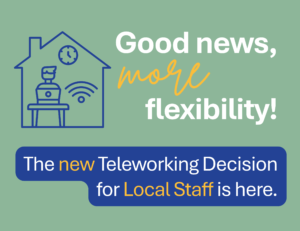 The new rules on voluntary teleworking apply to Local Staff in EU Delegations and Offices, who can now telework 1 full day per week or 2 half-days. Roles requiring physical presence, extensive face-to-face interaction or special handling of sensitive information, are generally excluded and cannot telework.
Generation 2004 survey on teleworking, teleworking from abroad and travelling to work
 Generation 2004 continues to fight for more teleworking days from abroad. In a situation where energy costs and fuel prices are continuously increasing, more flexibility on teleworking from anywhere would facilitate the life for many colleagues with family far away from their place of employment. More flexibility on teleworking from anywhere would also boost the attractiveness of our employer.
Generation 2004 lunchtime meeting: key updates
 *Update 30.06.2026: you can find here the presentation and the recording of the meeting*
On 26 June, Generation 2004 held an online lunchtime meeting to update members on key staff issues, followed by a Q&A session.
The meeting focused on the Commission’s Large-Scale Review, with Generation 2004 stressing that any reforms must respect the staff regulations, protect careers and be based on genuine social dialogue.
Continue reading Generation 2004 lunchtime meeting: key updates
The €900 Million question: What we still don’t know about the Commission’s building sell-off
 In our February article, The €900 million question: the Commission’s building sell-off and its consequences, Generation 2004 examined the Commission’s decision to sell 23 office buildings in Brussels for approximately €900 million and highlighted a number of questions regarding the long-term implications of this unprecedented real-estate transaction.
What are the limits of administrative discretion? A case that concerns us all
 Most of us joined the EU institutions believing that the rules would protect us. That professional performance would matter.
This case challenges that assumption. Continue reading What are the limits of administrative discretion? A case that concerns us all
